<?xml version="1.0" encoding="utf-8"?>
<feed xmlns="http://www.w3.org/2005/Atom" xmlns:media="http://search.yahoo.com/mrss/">
    <title>RailwaySurgery.org</title>
    <link href="https://railwaysurgery.org/feed.xml" rel="self" />
    <link href="https://railwaysurgery.org" />
    <updated>2026-09-16T19:20:59-05:00</updated>
    <author>
        <name>Robert Gillespie, MD, MPH</name>
    </author>
    <id>https://railwaysurgery.org</id>

    <entry>
        <title>Railway Surgery in the News</title>
        <author>
            <name>Robert Gillespie, MD, MPH</name>
        </author>
        <link href="https://railwaysurgery.org/railway-surgery-in-the-news/index.html"/>
        <id>https://railwaysurgery.org/railway-surgery-in-the-news/index.html</id>

        <updated>2026-09-15T21:31:55-05:00</updated>
            <summary type="html">
                <![CDATA[
                    My article in classic trains PBS feature Discovery magazine
                ]]>
            </summary>
        <content type="html">
            <![CDATA[
                
  <p>
    My article in classic trains
  </p>

  <p>
    PBS feature
  </p>

  <p>
    Discovery magazine
  </p>
            ]]>
        </content>
    </entry>
    <entry>
        <title>The Train Doctors:  A Brief History of Railway Surgery</title>
        <author>
            <name>Robert Gillespie, MD, MPH</name>
        </author>
        <link href="https://railwaysurgery.org/the-train-doctors-a-brief-history-of-railway-surgery-2/index.html"/>
        <id>https://railwaysurgery.org/the-train-doctors-a-brief-history-of-railway-surgery-2/index.html</id>

        <updated>2026-09-15T18:00:20-05:00</updated>
            <summary type="html">
                <![CDATA[
                    &nbsp;(There is also a longer version which contains all the content below, and more.) Railroad surgeons formed a unique medical specialty, operating a vast and innovative network of railroad hospitals and clinics.&nbsp; Nearly forgotten today, this relatively small but dedicated group of doctors made many&hellip;
                ]]>
            </summary>
        <content type="html">
            <![CDATA[
                
  <p>
    &nbsp;(There is also a <a href="https://railwaysurgery.org/a-detailed-history-of-railway-surgery/index.html">longer version</a> which contains all the content below, and more.)
  </p>

  <p>
    Railroad surgeons formed a unique medical specialty, operating a vast and innovative network of railroad hospitals and clinics.&nbsp; Nearly forgotten today, this relatively small but dedicated group of doctors made many advances in medical science and embraced an innovative payment system now used by many health insurance plans.
  </p>

    <h2 id="born-of-necessity">
      Born of Necessity
    </h2>

  <p>
    <br>&nbsp; &nbsp; &nbsp; &nbsp; &nbsp; As the nineteenth century unfolded, few employers offered employee benefit packages. &nbsp;Most workers had to secure medical care at their own expense.&nbsp; Some large industrial companies, particularly in the mining, lumber and steel industries, began to provide health care to employees during the mid-nineteenth century.&nbsp; The large number of injuries and the remote location of many work sites in the railroad industry led railroads to adopt similar plans.&nbsp; One surgeon reported that in 1897, 1693 railroad workers were killed and 27,667 injured.&nbsp; The opening of the transcontinental rail line and subsequent westward migration brought large numbers of people to remote areas devoid of doctors or hospitals, creating a crisis for those in need of medical attention.&nbsp; The earliest recorded railway surgeon may have been an individual known as “the railroad doctor,” whose name is now lost, working for the Erie Railroad in 1849.&nbsp; By the early twentieth century, every major railroad listed full-time doctors on its payroll.&nbsp;<br><br>&nbsp;&nbsp;&nbsp;&nbsp;&nbsp;&nbsp;&nbsp;&nbsp;&nbsp;&nbsp;&nbsp; Railroads divided the cost of these services, charging employees a fixed amount by payroll deduction, while the company funded the rest.&nbsp; Some charged a flat rate to all employees, while others scaled the cost based on salary.&nbsp; Most lines mandated participation, and many employees objected to the imposition.&nbsp; At a time when many people rarely, if ever, saw a doctor, the need for medical coverage must have appeared less than compelling.&nbsp; Surgical historian Ira Rutkow, M.D. noted that the early railway medical plans formed an important cause of labor strife.&nbsp; Over time, however, more workers accepted the plans, sometimes even requesting them.&nbsp; Statistics on the Plant system in 1896 showed that 98% of workers participated in the voluntary program.&nbsp;<br>
  </p>

    <h2 id="a-new-specialty-comes-of-age">
      A New Specialty Comes of Age
    </h2>

  <p>
    &nbsp;&nbsp;&nbsp;&nbsp;&nbsp;&nbsp;&nbsp;&nbsp;&nbsp;&nbsp;&nbsp; The railroad presented unique hazards and created new types of injuries unfamiliar to most doctors.&nbsp; Railway surgery quickly developed into a de facto medical specialty as the number of railroad-employed doctors swelled in the 1880s.&nbsp; Most railway “surgeons” were actually general practitioners who also performed surgery.&nbsp; Unlike older specialties, railway surgery had no hospital training programs; its practitioners learned their trade on the job, and later from the publications and conferences they produced.<br><br>&nbsp;&nbsp;&nbsp;&nbsp;&nbsp;&nbsp;&nbsp;&nbsp;&nbsp;&nbsp;&nbsp; As the fledgling specialty grew, railway surgeons began to organize in groups defined by railroads or geography.&nbsp; They formed professional societies and held meetings to propagate their specialized knowledge.&nbsp; The first such association, founded in 1882, carried the lengthy name of the Surgical Society of the Wabash, St. Louis and Pacific Railway East of the Mississippi River.&nbsp; At an 1887 meeting of the surgeons of the Pennsylvania Railroad, Dr. A. W. Ridenour proposed a national organization, representing surgeons from all railroads.&nbsp; As a result, a group met in Chicago in 1888 to establish the National Association of Railway Surgeons (NARS), which would become a prime mover in railway medicine.&nbsp; Within seven years NARS grew to over 1500 members out of some 6000 railway surgeons in practice.&nbsp; Its annual meeting resembled that of any major medical society, with hundreds of doctors attending to hear expert talks and learn of the latest research, while pharmaceutical and medical-supply representatives eagerly promoted their wares.<br><br>&nbsp; &nbsp; &nbsp; &nbsp; &nbsp; The railroads contributed free travel and other benefits to support the annual meetings.&nbsp; At the 1893 NARS convention in Omaha, the Union Pacific entertained the visitors and their spouses with a free excursion to Denver and Hot Springs, S.D.&nbsp; NARS officials in 1897 reported that 53 railroads offered free passes to any railway surgeon traveling over their lines.&nbsp; &nbsp;&nbsp;<br><br>&nbsp;&nbsp;&nbsp;&nbsp;&nbsp;&nbsp;&nbsp;&nbsp;&nbsp;&nbsp;&nbsp; United States President Benjamin Harrison invited official delegates from throughout the western hemisphere to the first Pan-American Medical Congress, to be held in Washington, D.C. in 1893.&nbsp; The event’s organizers asked NARS to assemble a section on railway surgery for the convention.&nbsp; Such official recognition demonstrated the increasing acceptance of railway surgery as a distinct and legitimate medical specialty.&nbsp;&nbsp;<br><br>&nbsp;&nbsp;&nbsp;&nbsp;&nbsp;&nbsp;&nbsp;&nbsp;&nbsp;&nbsp;&nbsp; Christian B. Stemen, M.D., chief surgeon for the Pennsylvania Railroad’s Ohio division and a founding member of NARS, wrote the first textbook of railway surgery in 1890.&nbsp; At the same time, The Railway Age and Northwestern Railroader devoted a regular column to railway surgery.&nbsp; This column quickly grew into a separate biweekly professional journal, The Railway Surgeon, beginning in 1894.&nbsp; Over 100 original scientific articles appeared in its pages each year.&nbsp; Detailed transcripts of the annual meetings provided an early form of distance learning for those who could not attend.&nbsp; Clinton Herrick, M.D., a surgeon for the Delaware and Hudson and the Fitchburg Railway, published another railway surgery textbook in 1899.&nbsp; These measures helped lend additional legitimacy to the fledgling specialty.<br><br>&nbsp;&nbsp;&nbsp;&nbsp;&nbsp;&nbsp;&nbsp;&nbsp;&nbsp;&nbsp;&nbsp; A large contingent of the non-railway medical establishment still refused to recognize railway surgeons.&nbsp; Railroads frequently hired surgeons by soliciting bids for contracts.&nbsp; Medical associations, not accustomed to competition, viewed this as a threat to all doctors’ incomes and attacked it vehemently.&nbsp; Many medical societies denied membership to all railway surgeons, and pressed for resolutions declaring their contracts unethical.&nbsp;&nbsp; Rutkow noted that the major surgery textbooks of the 1890s made no mention of railway surgery, and the specialty did not appear in the primary index of medical literature until 1903.&nbsp; However, mainstream medical journals such as the Journal of the American Medical Associationoccasionally reprinted articles from The Railway Surgeon, demonstrating respect for the scientific work of the railroad doctors. &nbsp;In addition to social isolation, railway surgeons stationed in remote areas also faced geographic isolation, living an austere lifestyle compared to their counterparts in the more cosmopolitan cities.<br><br>&nbsp;&nbsp;&nbsp;&nbsp;&nbsp;&nbsp;&nbsp;&nbsp;&nbsp;&nbsp;&nbsp; NARS also faced conflict from within.&nbsp; The association expelled Reed, editor of The Railway Surgeon, after he led an effort to create a competing society. &nbsp;Yet NARS continued to grow.&nbsp; In 1898 the association expanded to include Canada and Mexico, becoming the International Association of Railway Surgeons.&nbsp; This group and Reed’s rival organization, the American Academy of Railway Surgeons, put aside their differences in 1904, merging to become the American Association of Railway Surgeons.
  </p>

    <h2 id="he-has-been-jostled-and-bled-to-death">
      “He Has Been Jostled and Bled to Death"
    </h2>

  <p>
    <br>&nbsp;&nbsp;&nbsp;&nbsp;&nbsp;&nbsp;&nbsp;&nbsp;&nbsp;&nbsp;&nbsp; The injury victim in the early years of the Industrial Revolution faced a dismal prognosis, as doctors knew little about emergency care.&nbsp; Railroad workers fared especially poorly as they often sustained injuries at remote locations, far from medical assistance.&nbsp; Herrick described the typical plight of such a victim:
  </p>

    <blockquote class="blockquote">
      &nbsp;&nbsp;&nbsp;&nbsp;&nbsp;&nbsp;&nbsp;&nbsp;&nbsp;&nbsp;&nbsp; He was usually tied up with rope, old rags, soiled handkerchiefs, or anything else lying about, lifted into the first train, possibly some time after being hurt, with his crushed members dangling behind him unsupported; then sent along the road many miles in a cold damp car, each start and jar of which would almost close the scene. . .the crushed arm or leg so mixed up with clothing, gravel, sticks, etc., that the whole mass looks like nothing but bloody rubbish. . . He has been jostled and bled to death, and so he dies.
    </blockquote>

  <p>
    <br>&nbsp; &nbsp; &nbsp; &nbsp; &nbsp; Even when doctors could get to the scene, they often had to work outdoors or under poor conditions.&nbsp; “These operations out in the woods or on the back porch of some filthy house are sometimes criminal,” complained Dr. H. C. Fairbrother in 1894.&nbsp; Surgeons tried using hotel rooms, but the rooms lacked medical equipment, while the railroads accrued large bills to replace blood-stained furnishings.&nbsp; To provide better care to people injured far from proper facilities, railway surgeons of the late nineteenth century developed “emergency packs.”&nbsp; Carried on all trains, the packs contained medicines and sterile dressings.&nbsp; These emergency packs, predecessors of the ubiquitous first aid kit, allowed train crews to help victims immediately, using appropriate, clean supplies.&nbsp;&nbsp; Many doctors of the time objected, believing laypersons could not administer aid correctly, or fearing such activity might diminish the physician’s importance.<br><br>&nbsp; &nbsp; &nbsp; &nbsp; &nbsp; Drawing on military experience in the Civil War, the railway surgeons introduced railroad medical transport to civilian medicine.&nbsp; They developed sophisticated, specialized vehicles to dispatch to the site of an injury.&nbsp; The Baltimore &amp; Ohio Southwestern Railroad and the Central Railway of New Jersey introduced the first such “hospital cars” around 1894, and other railroads quickly followed.&nbsp; One common design provided a holding area for three to four patients and a fully stocked operating room.&nbsp; These cars provided a hospital-quality environment in which the surgeon could stabilize a patient before sending him or her on a long journey to a regular hospital.&nbsp; Such treatment ranged from simple wound cleansing to major surgical procedures.&nbsp; The specialty of anesthesiology had not yet developed in the late 1800s.&nbsp; The surgeons themselves provided anesthesia during their operations, using ether and chloroform.&nbsp; Railway surgeons presented many studies and expert reviews of anesthesia techniques in the pages of The Railway Surgeon and at conventions.&nbsp; Patients treated in hospital cars enjoyed better survival rates than those treated in dirty, makeshift conditions.&nbsp;
  </p>

    <h2 id="progressive-practices">
      Progressive Practices
    </h2>

  <p>
    <br>&nbsp;&nbsp;&nbsp;&nbsp;&nbsp;&nbsp;&nbsp;&nbsp;&nbsp;&nbsp;&nbsp; The emphasis on cleanliness and sterilization in the hospital cars reflected a growing trend in medical thought, one which railway surgeons embraced before such ideas enjoyed universal acceptance.&nbsp; Herrick devoted one chapter of his railway surgery textbook to sterilization techniques.&nbsp; He taught that under emergency conditions, surgeons could obtain hot water for sterilization from the locomotive boiler.&nbsp;<br><br>&nbsp; &nbsp; &nbsp; &nbsp; &nbsp; &nbsp;Railway surgeons also displayed a progressive attitude toward the promotion of women.&nbsp; The Railway Surgeon reported in 1894 that the Northern Pacific had appointed Dr. Carrie Lieberg of Hope, Idaho, to division surgeon.&nbsp; “This is the only instance of such distinction of a lady that we know of,” the journal said.&nbsp; An official of the St. Louis, Brownsville and Mexican Railway in Texas shocked observers in 1907 when he passed over several male applicants and hired a woman, Dr. Sofie Herzog, as the railroad’s chief surgeon. Sadly, this progressive approach did not extend to racial differences:&nbsp; the Santa Fe Hospital in Temple, Texas contained separate dining rooms for white, black and Mexican patients.<br><br>&nbsp;&nbsp;&nbsp;&nbsp;&nbsp;&nbsp;&nbsp;&nbsp;&nbsp;&nbsp;&nbsp; Railway surgeons did not limit their activities to railroad-related injuries; they provided a full spectrum of care. They treated all manner of illnesses, gave routine checkups, tested vision and hearing (see related page:&nbsp; Testing Vision and Hearing), performed elective surgery, delivered babies, and advised railroad officials on workplace safety and sanitation issues.
  </p>

    <h2 id="the-doctor-as-claim-adjuster">
      The Doctor as Claim Adjuster
    </h2>

  <p>
    &nbsp;&nbsp;&nbsp;&nbsp;&nbsp;&nbsp;&nbsp;&nbsp;&nbsp;&nbsp;&nbsp; Railway surgeons evaluated persons filing injury claims against the railroads.&nbsp; These examinations sought to determine the extent of injury as well as detect fraudulent claims.&nbsp; They also created an awkward conflict of interest, and lively debate as to whether the doctors worked for the best interests of the patient or the company.&nbsp; Dozens of articles in The Railway Surgeon and textbooks discussed management of these delicate situations.&nbsp; The physicians vigorously defended their integrity.&nbsp; “The railway never asked me to favor it in testimony,” said retired Florida East Coast Railway chief surgeon Vernon Lockwood, M.D., in 1963.&nbsp;&nbsp; Despite such assurances, the issue haunted the specialty until changes in procedures allowed injury victims to choose their own physicians.
  </p>

    <h2 id="the-railroad-hospital-and-hospital-association">
      The Railroad Hospital and Hospital Association
    </h2>

  <p>
    <br>&nbsp; &nbsp; &nbsp; &nbsp; &nbsp; The western railroads traversed rural areas and new settlements devoid of any substantial health care systems.&nbsp; Missouri Pacific chief surgeon Dr. Warren Outten noted that a person traveling between St. Louis and El Paso would go over 1300 miles without passing a single hospital.&nbsp; The Central Pacific Railroad faced a similar problem in California.&nbsp; Under the direction of vice-president A. M. Towne, the railroad opened its own hospital in Sacramento in 1869.&nbsp; That institution, which most historians recognize as the first exclusive railroad hospital, stimulated other railroads to develop similar facilities, and many more hospitals quickly appeared along the western rail lines.<br><br>&nbsp;&nbsp;&nbsp;&nbsp;&nbsp;&nbsp;&nbsp;&nbsp;&nbsp;&nbsp;&nbsp; Eastern railroads passed through older, well-developed cities, and these companies initially contracted with existing hospitals rather than invest in building separate hospitals.&nbsp; Twenty-five years after the Central Pacific Hospital opened, the Illinois Central and the Pennsylvania Railroad still lacked their own medical facilities.&nbsp; However, the railroad-owned hospitals afforded more control and the economies of scale and consolidation--benefits the eastern lines ultimately could not ignore.&nbsp; By 1896, 13 railroads operated 25 hospitals, treating over 165,000 patients annually. &nbsp;<br><br>&nbsp;&nbsp;&nbsp;&nbsp;&nbsp;&nbsp;&nbsp;&nbsp;&nbsp;&nbsp;&nbsp; Railroads also retained private physicians under contract in cities along their lines.&nbsp; These doctors were on call at all times to provide initial care at any railroad-related emergency, even if the injured was not an employee.&nbsp; The local doctors referred non-employee patients requiring further care to nearby hospitals, while the railroad transferred its own employees to the nearest company hospital.&nbsp; Only if an employee’s condition prevented safe transport would the railway pay for an outside hospital; even then, the company expected the patient to transfer to the nearest railroad hospital as soon as medical conditions permitted.&nbsp;<br><br>&nbsp;&nbsp;&nbsp;&nbsp;&nbsp;&nbsp;&nbsp;&nbsp;&nbsp;&nbsp;&nbsp; Railroad hospitals varied from small facilities resembling private homes to large medical centers such as the 300-bed Illinois Central Hospital in Chicago or the 450-bed Southern Pacific Hospital in San Francisco.&nbsp; The industry reached a peak of 3700 beds at 35 railroad hospitals around the country. &nbsp;The larger ones offered a range of services and facilities comparable to other leading hospitals of the time.&nbsp; The Santa Fe Hospital in Topeka, established in 1896, boasted innovative features such as forced air ventilation with a full air exchange every 10 minutes and independent heat control in each room.&nbsp; The Southern Pacific’s San Francisco facility became the second hospital in the nation to open an intensive care unit.&nbsp; Many of these hospitals operated nursing schools, internships, and residency training programs.&nbsp; Some manufactured pharmaceuticals or produced their own farm and dairy products.&nbsp; The railroads also maintained many more “emergency hospitals,” usually on the grounds of major yards or service facilities.&nbsp; Not true hospitals, these functioned as minor emergency clinics, typically housed in a one-room building and staffed by one doctor and nurse.&nbsp;<br><br>&nbsp;&nbsp;&nbsp;&nbsp;&nbsp;&nbsp;&nbsp;&nbsp;&nbsp;&nbsp;&nbsp; Descriptions of railway hospitals frequently mentioned efforts to create a relaxing environment for patients.&nbsp; Dr. Outten suggested that the camaraderie at a railroad hospital offered therapeutic value.&nbsp; “Railway men are naturally clannish,” he said, “and they take pride in direct contact and in discussing the diverse experiences of their vocation; and it is in the nature of a curative measure for railway men to have their surroundings thoroughly railroadish. . .”&nbsp; The Missouri Pacific Railroad Hospital at St. Louis, opened in 1884, provided musical instruments and a patient library with over 2800 volumes.&nbsp;<br><br>&nbsp;&nbsp;&nbsp;&nbsp;&nbsp;&nbsp;&nbsp;&nbsp;&nbsp;&nbsp;&nbsp; &nbsp; Early railroad hospitals accepted only railroad employees.&nbsp; However, some areas lacked alternative facilities, leading the hospitals to open their doors to the public.&nbsp; The Alaska Railroad Hospital in Anchorage accepted non-railroad patients from its opening in 1916 until a private hospital opened in 1939.&nbsp; The U.S. Army used the Alaska hospital at the beginning of World War II, during construction of the Army’s own facilities.&nbsp; In later years, many railroad hospitals accepted private patients to fill unused capacity and generate revenue to reduce employee charges.&nbsp;<br><br>&nbsp;&nbsp;&nbsp;&nbsp;&nbsp;&nbsp;&nbsp;&nbsp;&nbsp;&nbsp;&nbsp; The Florida East Coast Railway Hospital in St. Augustine provides an example of a large, busy railroad hospital.&nbsp; Operating from 1906 to 1963, at its peak it maintained 112 beds and provided all types of medical care, as well as a nurses’ training program.&nbsp; Most patients stayed in large wards with 10-15 beds, a common practice at the time.&nbsp; The railroad subsidized the hospital, keeping expenses to patients low.&nbsp; In 1930 a ward bed cost employees $3 a day, including all medications, tests and x-rays.&nbsp;<br><br>&nbsp; &nbsp; &nbsp; &nbsp; &nbsp; Some railroads even operated long-term care facilities.&nbsp; Southern Pacific maintained a tuberculosis sanitarium in a converted freight station in Tucson. &nbsp;The Santa Fe Hospital in Los Angeles accepted tuberculosis patients, housing them in heated and lighted tents on the hospital grounds.&nbsp;<br><br>&nbsp;&nbsp;&nbsp;&nbsp;&nbsp;&nbsp;&nbsp;&nbsp;&nbsp;&nbsp;&nbsp; The land, buildings and furnishings of a railroad hospital counted as taxable company assets.&nbsp; Many railroads opted to relieve themselves of the tax burden by creating independent foundations to own and operate the hospitals and health plans.&nbsp; These foundations, known as employee hospital associations (EHAs), also gave employees more representation in hospital management.&nbsp; The board of directors of an EHA hospital consisted of railway employees from a variety of occupations, typically one from each of the many unions representing them (see table below).&nbsp; In contrast, corporate executives managed the company-owned hospitals.&nbsp; Many EHAs obtained non-profit status, conferring more tax benefits and the ability to solicit donations, although&nbsp;&nbsp; the hospitals still relied on payroll deductions, patient payments, and company subsidies.&nbsp;<br><br>&nbsp;&nbsp;&nbsp;&nbsp;&nbsp;&nbsp;&nbsp;&nbsp;&nbsp;&nbsp;&nbsp; The EHAs published books of regulations which bear a striking resemblance, in principle, to modern managed-care handbooks.&nbsp; Members could use only designated hospitals and physicians; certain types of care and consultations required advance approval from the chief surgeon.&nbsp; Many benefits carried specific, sometimes draconian, limits.&nbsp; A Union Pacific handbook stated that diabetic patients taking insulin would receive only one syringe and two needles; the Frisco provided crutches, but would charge the patient if they were not returned.&nbsp; The Union Pacific, like many railroads, &nbsp;would not pay to treat sexually transmitted diseases or attempted suicide.&nbsp; UP would cover blood transfusions, but expected the recipient to supply donors to replace the blood!&nbsp;&nbsp; The strict limits and centralized approval process, very familiar to today’s managed-care consumer, represented radical concepts at the time.&nbsp; They challenged traditional views of the physician as an independent, unquestionable authority.&nbsp; Yet the techniques proved highly effective in controlling costs, setting an example that would dominate health care decades after the EHAs disappeared.
  </p>

    <h2 id="twilight-of-the-profession">
      Twilight of the Profession
    </h2>

  <p>
    <br>&nbsp;&nbsp;&nbsp;&nbsp;&nbsp;&nbsp;&nbsp;&nbsp;&nbsp;&nbsp;&nbsp; Railway surgery fell into decline early in the twentieth century.&nbsp; By 1921 The Railway Surgeon had changed its name to The Surgical Journal Devoted to Traumatic and Industrial Surgery.&nbsp; Activity in the surgeons’ professional associations dwindled.&nbsp; Several factors contributed to the demise of the system.&nbsp; Many patients disliked the requirement to see designated physicians or travel long distances to railway hospitals.&nbsp; They preferred to choose their own doctors in their home communities.&nbsp; Private insurance policies, prior to the 1980s, offered many choices with few restrictions.&nbsp; Railroad employees and unions pressed for these policies in place of the railroad doctor/hospital system.&nbsp; Injury victims requested doctors not affiliated with the railroad.&nbsp; Changes in government regulations, the creation of Medicaid and Medicare, and booming medical advances made the management of healthcare facilities progressively more complicated and expensive.&nbsp; Finally, railroad managers sought to divest unprofitable auxiliary enterprises such as hospitals.&nbsp; The remaining railway surgeons dispersed as the last railroad hospitals were sold or closed by the early 1970s.&nbsp; Many opened or joined other practices and continued to see their previous patients.<br><br>&nbsp; &nbsp; &nbsp; &nbsp; &nbsp; Several EHAs continue to operate into the present day, providing insurance benefits to railroad retirees. One of the oldest is the Wabash Memorial Hospital Association, founded in 1884.<br><br>&nbsp; &nbsp; &nbsp; &nbsp; &nbsp; Some railroad hospitals continued to operate as community hospitals, such as the Santa Fe Hospital in Temple, Texas, which grew into the Scott and White healthcare system, which to this day offers a prepaid medical plan similar to the railroad plans.&nbsp; Other railroad hospitals found new uses, such as the Southern Pacific Hospital in San Francisco, converted to housing, or the Houston facility, which serves as a county clinic.&nbsp; Many have been demolished.&nbsp; (See list page for updated status of some hospitals.)
  </p>

    <h2 id="the-legacy-of-the-railway-surgeons">
      The Legacy of the Railway Surgeons
    </h2>

  <p>
    <br>&nbsp;&nbsp;&nbsp;&nbsp;&nbsp;&nbsp;&nbsp;&nbsp;&nbsp;&nbsp; Railway surgeons left a lasting impact on the science of medicine.&nbsp; Their research and publications created the first modern study of trauma care.&nbsp; They helped shape the modern medical world with groundbreaking contributions in pre-hospital care, emergency medical transport, wound care, mass health screening and first aid.&nbsp; The surgeons called attention to public safety and sanitation issues, setting the stage for the modern specialty of occupational medicine.&nbsp; The descendant of The Railway Surgeon remains in print, now called Occupational Health and Safety.&nbsp;<br><br>&nbsp;&nbsp;&nbsp;&nbsp;&nbsp;&nbsp;&nbsp;&nbsp;&nbsp;&nbsp;&nbsp; The railway surgeons also helped shape the social aspects of medicine.&nbsp; They sought to deliver comprehensive health care to large numbers of people efficiently and economically--a challenging goal even today.&nbsp; Their innovative approaches to this problem, such as the prepaid health plan and the vertically integrated regional healthcare network, left a lasting contribution for future generations.<br><br><br><em>If you enjoyed this and want to learn more, read the <a href="https://railwaysurgery.org/a-detailed-history-of-railway-surgery/index.html">long version </a>of this history, which includes more details and the references used, or explore the <a href="https://railwaysurgery.org/railroad-hospitals/index.html">image gallery </a>or other areas of this website.</em><br><br><br><br><br><strong>Table:&nbsp; Board of Trustees of the Missouri-Kansas-Texas Railroad Employes’ Hospital Association</strong><br><br>One trustee is selected from each of the following organizations:<br><br>Conductors<br>Brakemen, switchmen and other trainmen<br>Engineers<br>Firemen<br>Station agents, telegraphers, levermen and linemen<br>Metal crafts and car department workers<br>Bridge, building, construction and trackmen<br>Clerks, general office, store and station employes<br>Signal men<br>Supervisory officers<br><br>Source:&nbsp; Missouri-Kansas-Texas Railroad Employes’ Hospital Association Charter, By-Laws and Rules and Regulations, 1950.<br><br><br>
  </p>
            ]]>
        </content>
    </entry>
    <entry>
        <title>Video test post</title>
        <author>
            <name>Robert Gillespie, MD, MPH</name>
        </author>
        <link href="https://railwaysurgery.org/video-test-post/index.html"/>
        <id>https://railwaysurgery.org/video-test-post/index.html</id>

        <updated>2026-09-11T21:25:10-05:00</updated>
            <summary type="html">
                <![CDATA[
                    Delete when finished.
                ]]>
            </summary>
        <content type="html">
            <![CDATA[
                <p>Delete when finished.</p>
<figure class="post__video"><video loading="lazy" width="300" height="150" controls="controls" data-mce-fragment="1">
<source src="https://catalog.archives.gov/id/25019?objectPage=9" /></video></figure>
            ]]>
        </content>
    </entry>
    <entry>
        <title>Additional Sources of Information</title>
        <author>
            <name>Robert Gillespie, MD, MPH</name>
        </author>
        <link href="https://railwaysurgery.org/additional-sources-of-information/index.html"/>
        <id>https://railwaysurgery.org/additional-sources-of-information/index.html</id>

        <updated>2026-09-09T21:12:45-05:00</updated>
            <summary type="html">
                <![CDATA[
                    Modern Articles Aldrich, Mark. Train wrecks to typhoid fever: the development of railroad medicine organizations, 1850 to World War I. Bulletin of the History of Medicine 2001;75:254-289. Cox, Mike. Dr. Sofie: frontier surgeon blazed a trail for other women to follow. Texas Medicine 1999; 95(9):41-3.
                ]]>
            </summary>
        <content type="html">
            <![CDATA[
                <h3>Modern Articles</h3>
<p style="font-weight: 400;">Aldrich, Mark.  Train wrecks to typhoid fever:  the development of railroad medicine organizations, 1850 to World War I.  <em>Bulletin of the History of  Medicine</em> 2001;75:254-289.</p>
<p style="font-weight: 400;">Cox, Mike.  Dr. Sofie:  frontier surgeon blazed a trail for other women to follow.  <em>Texas</em><em> Medicine</em> 1999; 95(9):41-3.</p>
<p style="font-weight: 400;">Kepner, Raymond B.  A brief history.  <em>Industrial Medicine and Surgery</em> 1963;32(9):349-50.</p>
<p style="font-weight: 400;">Lockwood, Vernon A.  The Florida East Coast Railway Hospital:  A study of early corporate medicine, 1906-1963.  <em>Journal of the Florida Medical Association</em> 1987;74(7):499-503.</p>
<p style="font-weight: 400;">Rutkow, Ira.  Railway surgery:  traumatology and managed health care in 19th-century United States.  <em>Archives of  Surgery</em> 1993;128(4):458-63.</p>
<p style="font-weight: 400;">Grant, H. Roger.  Railroad Rx.  <em>Railroad History</em> #192 Spring-Summer 2005: 8-15. (published by Railway and Locomotive Historical Society, Urbana, IL)</p>
<h3>Historical Journals</h3>
<p><strong>The Railway Surgeon</strong>.  The original professional journal of railway surgery, founded in 1894.  <em>Some volumes are available on Google Books.</em></p>
<h3>Books</h3>
<p style="font-weight: 400;"><em>All titles are out of print.  Libraries may be able to obtain them through interlibrary loan, </em><em>and the titles occasionally appear at online used book sellers.  Some titles are available on Google Books.</em></p>
<p style="font-weight: 400;">Short, Henry J.<strong>  <em>Railroad doctors, hospitals and associations:  pioneers in comprehensive low cost medical care</em></strong>.  Lakeport, Cal.:  Shearer/Graphic Arts, 1986.  A delightfully quirky reminiscence and history of railroad hospitals by a retired administrator for the Southern Pacific’s hospital system.</p>
<p style="font-weight: 400;">Stemen, Christian B.  <em><strong>Railway Surgery:  A Practical Work on the Special Department of Railway Surgery, for Railway Surgeons and Practitioners in the General Practice of Surger</strong>y.</em>  St. Louis, Mo.:  J.H. Chambers &amp; Co., 1890.  The first textbook of railway surgery.  <em>Available on Google Books.</em></p>
<p style="font-weight: 400;">Herrick, Clinton B.  <em><strong>Railway Surgery:  A Handbook on the Management of Injuries</strong>.</em>  New York:  William Wood and Co., 1899.  Another early and well-known textbook of railway surgery.  <em>Available on Google Books.</em></p>
<p style="font-weight: 400;"> </p>
            ]]>
        </content>
    </entry>
    <entry>
        <title>NEW and EXCLUSIVE!  Army Hospital Train Videos</title>
        <author>
            <name>Robert Gillespie, MD, MPH</name>
        </author>
        <link href="https://railwaysurgery.org/new-and-exclusive-army-hospital-train-videos/index.html"/>
        <id>https://railwaysurgery.org/new-and-exclusive-army-hospital-train-videos/index.html</id>
            <category term="Army Hospital Trains"/>

        <updated>2026-09-07T21:23:05-05:00</updated>
            <summary type="html">
                <![CDATA[
                    The U.S. Army produced miles of 35 mm films documenting activities of hospital trains and their personnel, both in the U.S. and abroad. These silent black-and-white films provide a fascinating and poignant look into their operations and the people involved. These films have been stored&hellip;
                ]]>
            </summary>
        <content type="html">
            <![CDATA[
                <p>The U.S. Army produced miles of 35 mm films documenting activities of hospital trains and their personnel, both in the U.S. and abroad.  These silent black-and-white films provide a fascinating and poignant look into their operations and the people involved.  These films have been stored in the National Archives near Washington, DC for decades.  Due to their age and fragility, they have not been available for viewing.  <strong>In 2026, RailwaySurgery.org was able to have them digitized.</strong>  We are proud to present them to be viewed for the <strong>first time in generations</strong>!  Head over to our <a href="https://railwaysurgery.org/motion-pictures/index.html">Motion Pictures</a> page and enjoy!</p>
            ]]>
        </content>
    </entry>
    <entry>
        <title>Become A Railway Surgeon!</title>
        <author>
            <name>Robert Gillespie, MD, MPH</name>
        </author>
        <link href="https://railwaysurgery.org/become-a-railway-surgeon/index.html"/>
        <id>https://railwaysurgery.org/become-a-railway-surgeon/index.html</id>

        <updated>2026-09-07T21:13:31-05:00</updated>
            <summary type="html">
                <![CDATA[
                    Railway surgery is a lost specialty today, a footnote in history. I'm sorry, you’ll have to find a different career. (May I suggest pediatric nephrology?) But let’s imagine that you are an aspiring doctor around the year 1900. Here’s what you might do to become&hellip;
                ]]>
            </summary>
        <content type="html">
            <![CDATA[
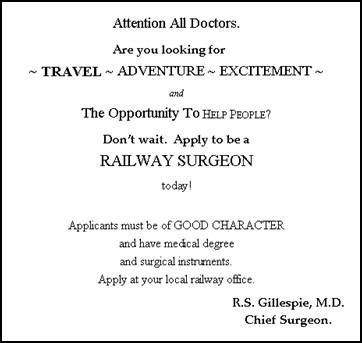
                <figure class="post__image post__image--center align-center"><img loading="lazy"  src="http://railwaysurgery.org/Become_files/image003.jpg" alt="" width="362" height="343" data-is-external-image="true"> </figure>
<p style="font-weight: 400;"><em>Railway surgery is a lost specialty today, a footnote in history.  I'm sorry, you’ll have to find a different career.  (May I suggest pediatric nephrology?) But let’s imagine that you are an aspiring doctor around the year 1900.  Here’s what you might do to become a railway surgeon:</em></p>
<ol>
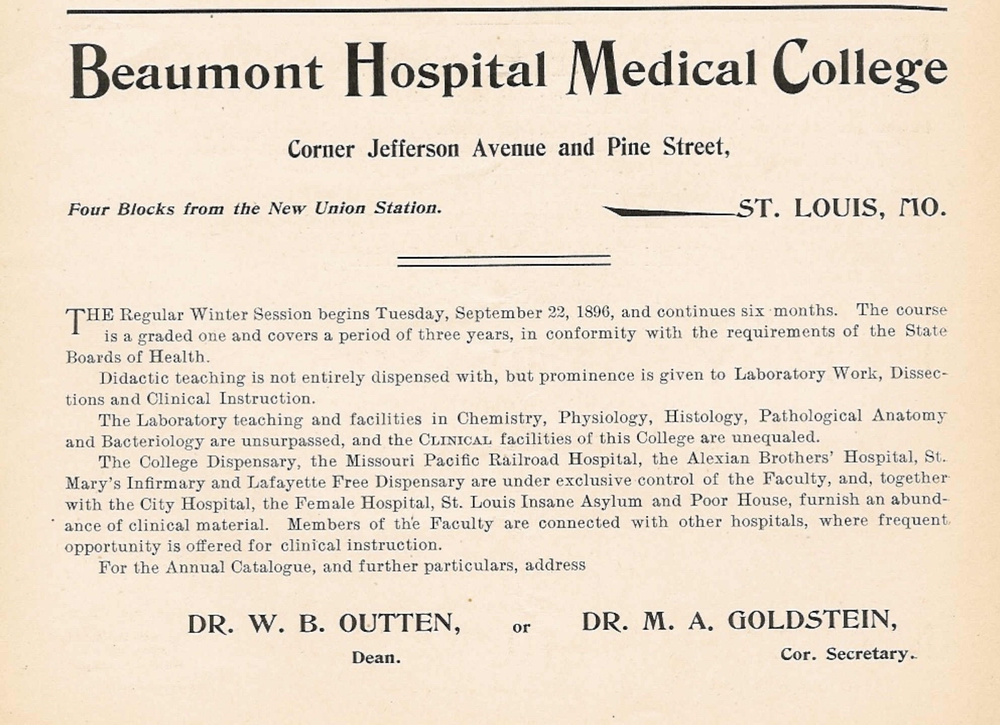
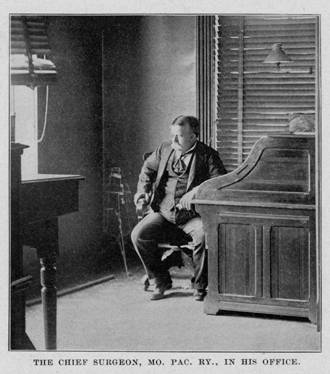
<li style="font-weight: 400;">Complete medical school.  Since the <a href="http://en.wikipedia.org/wiki/Flexner_Report">Flexner Report</a> won’t appear until 1910, you have about 160 medical schools from which to choose.  Entrance requirements, course work and costs are wildly different.  Try to pick a good one.  I recommend my alma mater, The University of Texas Medical Branch at Galveston, established in 1891.  It’s in a good railroad town and right on the beach.  The <strong>National Association of Railway Surgeons (NARS)</strong>, which you’ll be joining, held their convention in Galveston in 1894.  Or you might want to go to the Beaumont Hospital Medical College in St. Louis, below.  Dr. W. B. Outten, the dean (pictured below) is the Chief Surgeon of Missouri Pacific Railroad.  He’s also the president of the <strong>NARS</strong>.  So he’s a good person to know.<strong style="font-size: inherit;"> <br></strong></li>
</ol>
<figure class="post__image post__image--center"><img  src="http://railwaysurgery.org/Become_files/SchoolAdBig.jpg" alt="" width="1000" height="725" data-is-external-image="true"></figure> <figure class="post__image post__image--center"><img loading="lazy"  src="http://railwaysurgery.org/Become_files/image001.jpg" alt="" width="330" height="374" data-is-external-image="true"></figure>
<ol start="2">
<li style="font-weight: 400;">There is no official training program for railway surgery, but try to learn as much as you can about trauma.  Good skills in surgery and orthopedics will also come in quite handy. Be sure to read and study these two books:</li>
</ol>
<p style="font-weight: 400;"><em>Railway Surgery:  A Practical Work on the Special Department of Railway Surgery, for Railway Surgeons and Practitioners in the General Practice of Surgery </em>by Christian B. Stemen (1890)</p>
<p style="font-weight: 400;"><em>Railway Surgery:  A Handbook on the Management of Injuries</em> by Clinton B. Herrick (1899)</p>
<ol start="3">
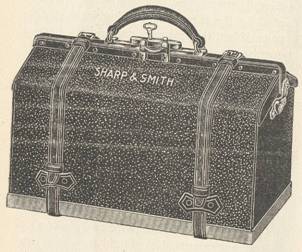
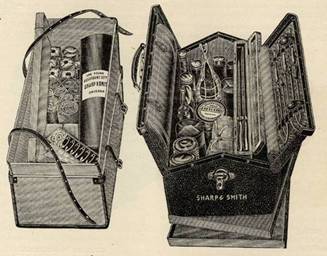
<li style="font-weight: 400;">If you have your own practice, and the railroad comes through your town, talk to railroad officials about becoming a “local surgeon.” As a local surgeon, you will have a contract with the railroad to be one of the first responders to any type of accident or injury on railroad property.  You can continue your regular practice, but you’ll also be on call for the railroad at all times.  Of course, you won’t have to carry a pager or cell phone – those have not been invented yet.  If the railroad needs you, it will likely summon you by sending someone to knock on your door. You’ll need a well-stocked bag such as the one below to take with you to emergencies.  Caution:  Expect at least a little friction, perhaps a lot, from the other doctors in town.  They won’t like the idea of you working under a contract for negotiated rates.</li>
</ol>
<figure class="post__image">       <img  src="http://railwaysurgery.org/Become_files/image005.jpg" alt="" width="302" height="252" data-is-external-image="true"></figure>      <figure class="post__image"><img loading="lazy"  src="http://railwaysurgery.org/Become_files/image006.jpg" alt="" width="327" height="256" data-is-external-image="true"></figure>
<ol start="4">
<li style="font-weight: 400;">Want to be a full-time railway surgeon?  Apply for a job with the railroad.  If they hire you, they will probably assign you to one of their large regional hospitals (see <a href="http://railwaysurgery.org/List.htm">list</a> and <a href="http://railwaysurgery.org/Gallery.htm">image gallery</a>), where you will join a medical staff of several other doctors and dozens of nurses.  They might also place you at an “emergency hospital.”  These are small urgent-care facilities, usually located around railroad stations were yards.  At an emergency hospital, you will be the only doctor, with one nurse to assist you. <br><br></li>
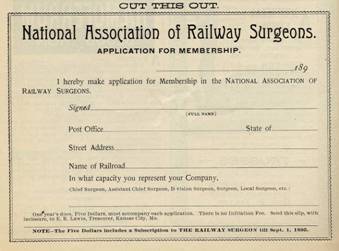
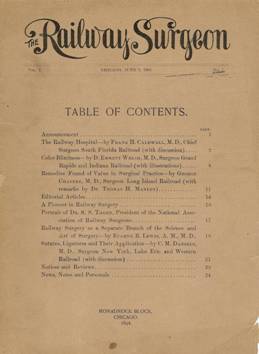
<li style="font-weight: 400;">Now fill out this application to join the <strong>National Association of Railway Surgeons (NARS)</strong>.  As a member, you’ll get a subscription to your journal, <em>The Railway Surgeon</em>.  Published twice a month, it’s full of interesting and educational articles.<br><br><figure class="post__image"><img  src="http://railwaysurgery.org/Become_files/image007.jpg" alt="" width="339" height="251" data-is-external-image="true"></figure>    <img loading="lazy" src="http://railwaysurgery.org/Become_files/image008.jpg" data-is-external-image="true"></li>
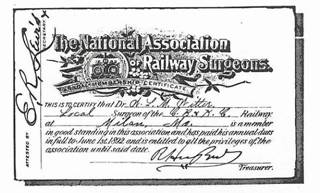
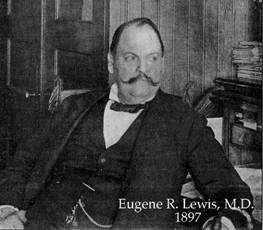
<li style="font-weight: 400;">NARS will also send you your membership card.  Dr. E. R. Lewis (pictured below) is the secretary of NARS.  He has signed your card on the left-hand edge.  Be sure to carry your card with you, and consider growing a handlebar mustache.  You can skip the mustache if you’re a woman.  Does railway surgery have opportunities for women in 1900?  Indeed, in 1894 the Northern Pacific appointed Dr. Carrie Lieberg of Hope, Idaho as division surgeon, and in 1907 the St. Louis, Brownsville and Mexican Railway in Texas will hire Dr. Sofie Herzog as their chief surgeon.<br><br><img src="http://railwaysurgery.org/Become_files/image009.jpg" data-is-external-image="true"><figure class="post__image"><img loading="lazy"  src="http://railwaysurgery.org/Become_files/image010.jpg" alt="" width="263" height="230" data-is-external-image="true"></figure></li>
</ol>
<ol start="7">
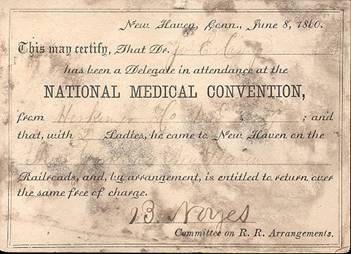
<li style="font-weight: 400;">Plan to attend the NARS annual meetings.  They have many educational lectures and presentations, which will refresh your medical knowledge and teach you about the latest developments. The railroads will usually give you a free train ticket to go to the meeting.  Here are your railroad pass and your pin for the meeting:<br><br><figure class="post__image"><img  src="http://railwaysurgery.org/Become_files/image011.jpg" alt="" width="351" height="254" data-is-external-image="true"></figure> <img loading="lazy" src="http://railwaysurgery.org/Become_files/image012.jpg" data-is-external-image="true"></li>
</ol>
<ol start="8">
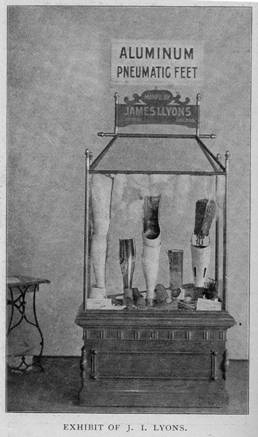
<li style="font-weight: 400;">At the meeting, you’ll get to meet other railway surgeons.  You will also see exhibits from drug companies and manufacturers of medical equipment.  Here is a display from a company selling artificial limbs.  Be sure to pick up their catalog - you’ll prescribe quite a few artificial limbs at your new job. <br><br><figure class="post__image post__image--center"><img loading="lazy"  src="http://railwaysurgery.org/Become_files/image014.jpg" alt="" width="258" height="437" data-is-external-image="true"></figure></li>
</ol>
<ol start="10">
<li style="font-weight: 400;">Now enjoy your satisfying career as a <strong>railway surgeon</strong>!  A century from now, some crazy doctor in Texas will create a website about you. </li>
</ol>
            ]]>
        </content>
    </entry>
    <entry>
        <title>About Me</title>
        <author>
            <name>Robert Gillespie, MD, MPH</name>
        </author>
        <link href="https://railwaysurgery.org/about/index.html"/>
        <id>https://railwaysurgery.org/about/index.html</id>

        <updated>2026-09-07T19:15:28-05:00</updated>
            <summary type="html">
                <![CDATA[
                    I'm Robert S. Gillespie, M.D., M.P.H., the creator of RailwaySurgery.org. My interest in railway surgery developed as the logical combination of my love of trains and history mixed with a career in medicine. I have spent many years researching the history of railroad medical systems. I&hellip;
                ]]>
            </summary>
        <content type="html">
            <![CDATA[
                <figure class="post__image post__image--right"><img loading="lazy"  src="https://railwaysurgery.org/media/posts/9/1.jpg" alt="Photo of author" width="2987" height="3604" sizes="(min-width: 37.5em) 1600px, 88vw" srcset="https://railwaysurgery.org/media/posts/9/responsive/1-xs.jpg 640w ,https://railwaysurgery.org/media/posts/9/responsive/1-sm.jpg 768w ,https://railwaysurgery.org/media/posts/9/responsive/1-md.jpg 1024w ,https://railwaysurgery.org/media/posts/9/responsive/1-lg.jpg 1366w ,https://railwaysurgery.org/media/posts/9/responsive/1-xl.jpg 1600w"></figure>I'm Robert S. Gillespie, M.D., M.P.H., the creator of RailwaySurgery.org.  My interest in railway surgery developed as the logical combination of my love of trains and history mixed with a career in medicine.  I have spent many years researching the history of railroad medical systems. </p>
<p>I earned my Doctor of Medicine degree at the University of Texas Medical Branch at Galveston, and a Master of Public Health degree at the University of Washington.  I now practice pediatric nephrology in Fort Worth, Texas and surrounding areas.</p>
<p style="font-weight: 400;">I have published many articles in scientific and popular publications, including <em>Trains</em>, <em>Classic Trains</em>, <em>Michigan History</em>, <em>eMedicine.com</em>, <em>Pediatrics in Review</em> and <em>Pediatric Nephrology</em>.  I serve on the faculty of the Texas Christian University Burnett School of Medicine and the Texas College of Osteopathic Medicine at the University of North Texas. I have been interviewed by KIII-TV (ABC), KZTV (CBS) and KORO (Univision) in south Texas.  I have also served as a consultant to the Food and Drug Administration, and as a reviewer for scientific journals, including <em>Pediatric Nephrology</em>, <i>Pediatrics </i>and <em>Nature Clinical Practice: Nephrology</em>.  </p>
<p>RailwaySurgery.org went online in 2006.  This site is my passion project and a labor of love to honor the legacy of the dedicated railway surgeons and military hospital train staff.  If you want to talk about railway medicine or would like for me to speak to your group, drop me a line!</p>
<p>Rob</p>
            ]]>
        </content>
    </entry>
    <entry>
        <title>Army Hospital Trains</title>
        <author>
            <name>Robert Gillespie, MD, MPH</name>
        </author>
        <link href="https://railwaysurgery.org/army-hospital-trains/index.html"/>
        <id>https://railwaysurgery.org/army-hospital-trains/index.html</id>
            <category term="Army Hospital Trains"/>

        <updated>2026-09-07T19:13:25-05:00</updated>
            <summary type="html">
                <![CDATA[
                    Text goes here
                ]]>
            </summary>
        <content type="html">
            <![CDATA[
                <p>Text goes here</p>
            ]]>
        </content>
    </entry>
    <entry>
        <title>A Detailed History of Railway Surgery</title>
        <author>
            <name>Robert Gillespie, MD, MPH</name>
        </author>
        <link href="https://railwaysurgery.org/a-detailed-history-of-railway-surgery/index.html"/>
        <id>https://railwaysurgery.org/a-detailed-history-of-railway-surgery/index.html</id>

        <updated>2026-09-07T18:53:44-05:00</updated>
            <summary type="html">
                <![CDATA[
                    June 5, 1870 A brakeman at a remote western mine siding is attempting to guide a link-and-pin coupler into its slot when he slips on an oily crosstie. His hand is crushed between the couplers. The fireman, not knowing what to do, wraps an oily&hellip;
                ]]>
            </summary>
        <content type="html">
            <![CDATA[
                <p style="font-weight: 400;"> </p>
<p style="font-weight: 400;">June 5, 1870</p>
<p style="font-weight: 400;"><em>          A brakeman at a remote western mine siding is attempting to guide a link-and-pin coupler into its slot when he slips on an oily crosstie.  His hand is crushed between the couplers.  The fireman, not knowing what to do, wraps an oily rag around the stump.  He lifts the brakeman into the caboose as the partly severed hand dangles in the wind.  The nearest hospital is hundreds of miles away, but the conductor hopes to find a doctor in a large settlement down the line.  In the meantime he can offer his comrade no comfort other than a few sips of water.  The brakeman’s cries of pain grow softer and the pool of blood beside him grows larger during two-hour journey.  He is unconscious when the train arrives at the settlement two hours later, and the crew carries him to a room in the station hotel.  A local doctor amputates the hand, but gangrene develops in the wound.  The brakeman begins to have fever and chills, and dies a few days later. </em></p>
<p style="font-weight: 400;">July 17, 1897</p>
<p style="font-weight: 400;"><em>          A rookie flagman walking between cars at the same remote siding fails to notice the train starting to move.  The car strikes him and throws him to the ground, but his pants leg catches in the running gear.  The conductor sees the flagman on the ground and halts the train.  He finds his coworker with a broken leg, the jagged bone protruding from a bleeding wound.  The conductor opens the emergency kit from the caboose and wraps the wound with sterile gauze to reduce the bleeding, then stabilizes the leg with a wooden splint.  He gives the injured man medicines for pain and shock, while the fireman runs into town to summon the local surgeon on call for the railroad.  The superintendent at a division point 100 miles away receives an urgent telegraph message and immediately calls a train crew.  Scheduled trains are held in sidings as Extra 107 rushes to the scene with the railway’s own surgeon, a recognized expert in trauma care, on board.  The locomotive pulls a single specially built car with a fully equipped operating room. Using a stretcher they transfer the patient to the hospital car, where the surgeon places the man under general anesthesia.  The doctor dons a clean gown and sterilizes his hands with carbolic acid before setting the fractured bone and suturing the wound.  When the flagman wakes up, the train is en route to the railroad’s own hospital, the only one in the region, where he will remain for several weeks of wound care and rehabilitation.   At discharge his leg is well healed and he will soon return to work.  He is not charged for any of the care he has received.</em></p>
<p style="font-weight: 400;"> </p>
<p style="font-weight: 400;">          Railway surgeons, nearly forgotten today, once formed the nucleus of a vast and innovative health care network.   These two fictional vignettes illustrate some of the remarkable improvements in medical care the railway surgeons developed.   This relatively small but dedicated group of doctors made substantial advances in treatment, prevention, safety and hygiene, creating an intricate system that served as a model for many modern medical plans.</p>
<h1>Born of Necessity</h1>
<p style="font-weight: 400;">          As the nineteenth century unfolded, few employers offered any kind of employee benefit packages.   Workers had to secure medical care privately and at their own expense.  Businesses only paid physicians to perform pre-employment physical exams or to assist them with matters of work site hygiene.  Railroads developed into an exception to this rule, in part due to the inordinate number of injuries sustained by employees, passengers and bystanders.  The Interstate Commerce Commission reported in 1900 that 1 of every 28 railroad employees was injured on the job, and 1 in 399 was killed<a name="_ednref1"></a><a href="http://railwaysurgery.org/HistoryLong.htm#_edn1">[1]</a>.  Railroads initially relied on contracts with private doctors along their lines, but the huge number of visits soon made hiring dedicated railroad physicians a practical option.  In addition, the opening of the transcontinental rail line and the subsequent westward migration brought large numbers of people to remote undeveloped areas devoid of doctors or hospitals.  The western railroads had no choice but to bring in physicians and establish health care facilities.  By the early twentieth century, every major railroad listed full-time doctors on its payroll. </p>
<p style="font-weight: 400;">            Railroads divided the cost of these services, with employees paying a fixed amount by mandatory payroll deduction and the company funding the rest.  A few lines kept participation voluntary, but employees who did not elect to pay the monthly fee could not take advantage of the free services offered.  Some companies charged a flat rate to all employees, while others used a graduated fee based on the worker’s salary<a name="_ednref2"></a><a href="http://railwaysurgery.org/HistoryLong.htm#_edn2">[2]</a>(<a href="http://railwaysurgery.org/HistoryLong.htm#Table1">Table 1</a>).  The plans initially drew vocal objections from the railway employees upset with the involuntary cut in pay.  At a time when many people passed their entire lives without seeing a doctor, and most women delivered their children at home, the need for medical coverage must have appeared less than compelling.  Surgical historian Ira Rutkow, M.D. noted that the railway medical plans formed an important cause of labor strife in their early years<a name="_ednref3"></a><a href="http://railwaysurgery.org/HistoryLong.htm#_edn3">[3]</a>.  George Chaffee, M.D., a surgeon for the Long Island Railroad, spoke of the benefits of the system:</p>
<blockquote>
<p style="font-weight: 400;">When an employe falls sick or is injured--where this system is in operation--he is promptly, and with care, removed to the company’s hospital, an institution in which he is himself a stockholder and part owner, and in which, by his monthly assessments, his bills are paid in advance, an item of no small account.  Employes are not all able to be treated in luxurious homes, but their cuts, fractures and injuries are just as sore and painful as thought they were able to afford the best of everything.  The simple adoption of this system on the part of the company, and the consent of the employe to the light monthly assessment, will place him in a position to receive and enjoy the very best treatment in the land, and when cured he will be discharged from the hospital and returned to his position at the earliest possible moment--free from debt<a name="_ednref4"></a><a href="http://railwaysurgery.org/HistoryLong.htm#_edn4">[4]</a>.</p>
</blockquote>
<p style="font-weight: 400;">          Dr. Chaffee proceeded to read glowing testimonials from satisfied patients, but one has no way of knowing if those opinions represented the majority of workers.  Over time, more workers began to accept the plans.  R. Harvey Reed, M.D., a key player in the development of railway surgery, commented that “When I first heard of the hospital system I was opposed to it, but after seeing how it was conducted and inquiring of the men along the line of these roads I found there was not a single expression of disapproval from them, and if put to a vote to-day I believe that at least ninety-five out of every hundred employes would vote for its maintenance<a name="_ednref5"></a><a href="http://railwaysurgery.org/HistoryLong.htm#_edn5">[5]</a>.”   Indeed, statistics on the Plant system, a Florida railroad network, in 1896 showed 98 percent of workers joined the voluntary program, receiving not only free medical care but also a daily cash benefit for illness, and a death benefit.  The employee contributions, along with the cash benefits, followed a graduated scale based on salary, but all participants received the same medical benefits<a name="_ednref6"></a><a href="http://railwaysurgery.org/HistoryLong.htm#_edn6">[6]</a>. </p>
<h2 style="font-weight: 400;"><strong>A New Specialty Comes of Age</strong></h2>
<p style="font-weight: 400;">            The railroad presented unique hazards and created new types of injuries to which most doctors were not accustomed. Railway surgery quickly developed into a <em>de facto</em> medical specialty, as the number of railroad-employed doctors swelled in the late 1880s.  No single physician holds the title of founder of the specialty.  One railway surgeon in 1894 suggested this honor belonged to an unnamed individual, known as “the railroad doctor,” who worked for the Erie Railroad in 1849<a name="_ednref7"></a><a href="http://railwaysurgery.org/HistoryLong.htm#_edn7">[7]</a>.  Most railway surgeons were actually general practitioners who also performed surgery<a name="_ednref8"></a><a href="http://railwaysurgery.org/HistoryLong.htm#_edn8">[8]</a>.  Railway surgery had no special training program or certification board; its practitioners learned their trade on the job, and later from the journals and conferences they produced.</p>
<p style="font-weight: 400;">            As the fledgling specialty grew, railway surgeons began to organize in groups defined by geographic areas or railroads.  They formed professional societies and held conferences to propagate their specialized knowledge and address issues pertinent to the group.  The first such association, founded in 1882, carried the lengthy name of the Surgical Society of the Wabash, St. Louis and Pacific Railway East of the Mississippi River<a name="_ednref9"></a><a href="http://railwaysurgery.org/HistoryLong.htm#_edn9">[9]</a>.  At the 1887 meeting of the surgeons of the Pennsylvania Railroad, Dr. A. W. Ridenour presented a resolution calling for the formation of a nationwide organization, representing surgeons from all railroads<a name="_ednref10"></a><a href="http://railwaysurgery.org/HistoryLong.htm#_edn10">[10]</a>.  The resolution passed, and in 1888 a group met in Chicago for the first meeting of the National Association of Railway Surgeons (NARS), which would become a prime mover in railway medicine.  Within seven years it grew to over 1500 members<a name="_ednref11"></a><a href="http://railwaysurgery.org/HistoryLong.htm#_edn11">[11]</a> out of some 6000 railway surgeons in practice<a name="_ednref12"></a><a href="http://railwaysurgery.org/HistoryLong.htm#_edn12">[12]</a>.  Its annual meeting, held in major cities (<a href="http://railwaysurgery.org/HistoryLong.htm#Table2">Table 2</a>), resembled that of any major medical society, with hundreds of doctors in attendance to hear expert talks and learn of the latest research, while pharmaceutical and manufacturing representatives eagerly promoted their wares in adjacent exhibition halls.  The 1897 convention in Chicago drew 38 exhibitors<a name="_ednref13"></a><a href="http://railwaysurgery.org/HistoryLong.htm#_edn13">[13]</a>(<a href="http://railwaysurgery.org/HistoryLong.htm#Table3">Table 3</a>), and a daily journal chronicled the lectures.</p>
<p style="font-weight: 400;">          The railroads supported the annual meetings by contributing free travel and other benefits.  NARS officials in 1897 requested travel passes from 54 railroads; all but one agreed to provide such, not only to their own surgeons, but also to any railway surgeon traveling over their lines.<a name="_ftnref1"></a><a href="http://railwaysurgery.org/HistoryLong.htm#_ftn1">(a)</a> <a name="_ednref14"></a><a href="http://railwaysurgery.org/HistoryLong.htm#_edn14">[14]</a>.  Both major sleeping-car operators, the Pullman Palace Car Company and the Wagner Palace Car Company, offered railway surgeons a free return trip with an outbound sleeping accommodation purchase<a name="_ednref15"></a><a href="http://railwaysurgery.org/HistoryLong.htm#_edn15">[15]</a>.  At the 1893 NARS convention in Omaha, the Union Pacific entertained the visitors and their spouses with a free Pullman-car excursion to Denver and Hot Springs, S.D.  The meeting’s minutes note that the assembly gave U.P. and Pullman three cheers in gratitude<a name="_ednref16"></a><a href="http://railwaysurgery.org/HistoryLong.htm#_edn16">[16]</a>. </p>
<p style="font-weight: 400;">            The United States Congress passed a resolution in 1892 authorizing President Benjamin Harrison to invite government officials throughout the western hemisphere to send official delegates to the first Pan-American Medical Congress, to be held in Washington, D.C. the following year.  The event’s organizers asked the NARS to assemble a section on railway surgery for the convention<a name="_ednref17"></a><a href="http://railwaysurgery.org/HistoryLong.htm#_edn17">[17]</a>.  Such official recognition showed increasing public acceptance of railway surgery as a distinct and legitimate medical specialty.   Speaking at that conference, Eugene Lewis, M.D. noted that the unique forms and conditions of injuries on railways required special experience in their care and attention, adding that  “I concede that history has not yet recorded railway surgery as a permanent branch of the art and science of surgery, but time only is needed for such record. . .and the leaders of this great congress will have said to the world, ‘We recognize railway surgery<a name="_ednref18"></a><a href="http://railwaysurgery.org/HistoryLong.htm#_edn18">[18]</a>. . .’”  </p>
<p style="font-weight: 400;">            Christian B. Stemen, M.D.<a name="_ftnref2"></a><a href="http://railwaysurgery.org/HistoryLong.htm#_ftn2">(b)</a>, chief surgeon for the Pennsylvania Railroad’s Ohio division, wrote the first textbook of railway surgery<a name="_ednref19"></a><a href="http://railwaysurgery.org/HistoryLong.htm#_edn19">[19]</a> in 1890.  At the same time, the railroad trade journal <em>The Railway Age and Northwestern Railroader</em> devoted a regular column to railway surgery, written by NARS members. This column quickly grew into the association’s own biweekly professional journal, <em>The Railway Surgeon,</em> beginning in 1894 and published by the same company.  Over 100 original scientific articles appeared in its pages each year. Detailed transcripts of the annual meetings provided an early form of distance learning for those who could not attend.  Clinton Herrick, M.D., a surgeon for the Delaware and Hudson and the Fitchburg Railway, published another railway surgery textbook in 1899<a name="_ednref20"></a><a href="http://railwaysurgery.org/HistoryLong.htm#_edn20">[20]</a>.  These measures helped lend additional legitimacy to the fledgling specialty.</p>
<p style="font-weight: 400;">            A large contingent of the medical establishment still refused to recognize railway surgeons.  Railroads frequently selected railway surgeons using the well-accepted business practice of competitive bidding, awarding the contract to the lowest bidder.  Medical associations, not accustomed to competition, viewed this as a threat to all doctors’ incomes and attacked it vehemently.  Many medical societies denied membership to all railway surgeons<a name="_ednref21"></a><a href="http://railwaysurgery.org/HistoryLong.htm#_edn21">[21]</a>, and pressed for resolutions declaring contract medicine unethical<a name="_ednref22"></a><a href="http://railwaysurgery.org/HistoryLong.htm#_edn22">[22]</a>.   Mainstream medical publications seldom mentioned railway surgery topics, even though the care provided by railway surgeons comprised a substantial portion of the total medical practice in the United States.  Dr. Rutkow noted that the major surgery textbooks of the 1890s made no mention of railway surgery, and the specialty did not appear in <em>Index Medicus</em>, the major index of medical literature, until 1903<a name="_ednref23"></a><a href="http://railwaysurgery.org/HistoryLong.htm#_edn23">[23]</a>. In addition to this social isolation, railway surgeons stationed in remote areas also faced geographic isolation, living a rugged and austere lifestyle compared to their counterparts in the more cosmopolitan cities.</p>
<p style="font-weight: 400;">            A war of words between <em>The Railway Surgeon</em> and the <em>Journal of the American Medical Association</em> illustrates some of the tension between the railway surgeons and mainstream medicine.  In 1895, the <em>Journal</em> published an unauthorized abstract of the proceedings of the eighth annual NARS convention, noting that “. . .The <em>Journal</em> takes pleasure in rescuing from oblivion the very excellent papers that otherwise would have been buried in the pages of an exclusive periodical<a name="_ednref24"></a><a href="http://railwaysurgery.org/HistoryLong.htm#_edn24">[24]</a>.”  An unnamed <em>Railway Surgeon</em> editor blasted the abstract as incomplete and inaccurate. “This piece of discourtesy on the part of the <em>Journal</em> is extremely unkind and entirely uncalled for. . . ,” he complained.  “[<em>Journal</em> Editor]  Dr. Hamilton has our sincere sympathy whenever he is obliged to be away and leave the devil to get out the <em>Journal</em>.”  This incident suggests that despite the social tension, mainstream doctors respected the scientific work of the railway surgeons.</p>
<p style="font-weight: 400;">            NARS also faced conflict from within.  Although many details have been lost to time, several news items in <em>The Railway Surgeon</em> suggest that its own editor, Dr. Reed, led an attempt to establish a rival society called the American Academy of Railway Surgeons.  Reportedly the organizers stated that NARS had become too “promiscuous,” and they desired a more selective body of less than 200 members, “confined to only the more eminent surgeons in railway service<a name="_ednref25"></a><a href="http://railwaysurgery.org/HistoryLong.htm#_edn25">[25]</a>.”  NARS promptly expelled Dr. Reed from the editor’s desk, replacing him with Missouri Pacific chief surgeon Warren B. Outten, M. D.  Dr. Outten was no stranger to NARS; he had been elected to the Executive Committee at the first meeting, and would later serve as president<a name="_ednref26"></a><a href="http://railwaysurgery.org/HistoryLong.htm#_edn26">[26]</a>.  Local and regional railway surgery associations sent letters expressing their support for NARS and condemning the rival society.  In a typical letter, the Southwestern Association of Railway Surgeons wrote, “We . . . pledge our hearty and loyal support to the National Association, and regret that a few disgruntled and defeated candidates for office should seek to injure the association<a name="_ednref27"></a><a href="http://railwaysurgery.org/HistoryLong.htm#_edn27">[27]</a>.”   Several months later, <em>The</em> <em>Railway Surgeon </em>commented:  “A year ago the future of the NARS seemed to some to be not a little uncertain.  Personal differences had arisen in the membership which many were interested in magnifying as much as possible.  The great mass of members of the association, however, never swerved from the course which has been marked out.  The association was too big and strong--its work too large and its mission too good--for it to be checked by any purely personal influences. . .Within the year all semblance of opposition which is worth considering--all possibility of doubt as to the future of the association --has died away.<a name="_ednref28"></a><a href="http://railwaysurgery.org/HistoryLong.htm#_edn28">[28]</a>”  NARS continued to grow.  In 1898 it expanded to include Mexico and Canada, becoming the International Association of Railway Surgeons.  However, the rival American Academy of Railway Surgeons had not vanished.  The two organizations put aside their differences in 1904 and merged to become the American Association of Railway Surgeons<a name="_ftnref3"></a><a href="http://railwaysurgery.org/HistoryLong.htm#_ftn3">(c)</a><a name="_ednref29"></a><a href="http://railwaysurgery.org/HistoryLong.htm#_edn29">[29]</a>.</p>
<h1>“He Has Been Jostled and Bled to Death”</h1>
<p style="font-weight: 400;">            The injury victim in the early years of the Industrial Revolution faced a dismal outlook.  To make matters worse, observed James Hunt, M.D., of Utica, New York, “[m]any of these accidents happen at night, and at some out-of-the-way place, distant from medical assistance, and frequently in the most disagreeable weather<a name="_ednref30"></a><a href="http://railwaysurgery.org/HistoryLong.htm#_edn30">[30]</a>”.    Dr. Herrick described the plight of an accident victim in an era lacking scientific knowledge of emergency care:</p>
<blockquote>
<p style="font-weight: 400;">                Take the usual instance of a man severely injured, as, for example, having one or both arms or legs crushed.  He was usually tied up with rope, old rags, soiled handkerchiefs, or anything else lying about, lifted into the first train, possibly some time after being hurt, with his crushed members dangling behind him unsupported; then sent along the road many miles in a cold, damp car, each start and jar of which would almost close the scene, only soon after to be hustled into an ambulance and hurried to the hospital. . .[There] he presents a pallid, grimy appearance, is pulseless, cold, stupefied; the crushed arm or leg so mixed up with clothing, gravel, sticks, etc., that the whole mass looks like nothing but bloody rubbish. . He has been jostled and bled to death, and so he dies<a name="_ednref31"></a><a href="http://railwaysurgery.org/HistoryLong.htm#_edn31">[31]</a>.</p>
</blockquote>
<p style="font-weight: 400;">          When doctors could treat a patient at the scene of the injury, they frequently worked in poor conditions.  One railway surgeon complained that  “every injured man. . . has a right to expect proper treatment, and these operations out in the woods or on the back porch of some filthy house are sometimes criminal<a name="_ednref32"></a><a href="http://railwaysurgery.org/HistoryLong.htm#_edn32">[32]</a>.”  Railway surgeons tried using hotel rooms for emergency care, but the rooms were not suitably equipped, and the railroads accumulated large bills for room charges as well as replacement of bloodstained furnishings<a name="_ednref33"></a><a href="http://railwaysurgery.org/HistoryLong.htm#_edn33">[33]</a>.  To meet the challenge of providing better care to people injured far from medical facilities, railway surgeons developed emergency packs, containing medicines and sterile dressings, to be carried on all trains.  These packs, the forerunners of the ubiquitous first aid kit, allowed railroad workers to treat patients with appropriate, clean supplies even if the railway surgeon could not immediately reach the scene.    Dr. Hunt and others also trained railway workers in the equivalent of first aid techniques, using a mannequin, skeleton and charts<a name="_ednref34"></a><a href="http://railwaysurgery.org/HistoryLong.htm#_edn34">[34]</a>.  Many doctors of the time objected, believing laypersons could not administer aid correctly, or fearing that the physician’s importance might be diminished.</p>
<p style="font-weight: 400;">            The railway surgeons also promoted the development and use of hospital cars, which could be taken to the site of a serious injury.  Military experience during the Civil War had shown that railroad transportation could provide effective medical evacuation.  Both the Union and Confederate armies had made extensive use of freight cars or hastily improvised bunk cars to transport injured soldiers to regional hospitals<a name="_ednref35"></a><a href="http://railwaysurgery.org/HistoryLong.htm#_edn35">[35]</a>.  The railway surgeons introduced the concept to civilian medicine and developed highly sophisticated cars.  The first such cars entered service around 1894 on the Central Railway of New Jersey<a name="_ednref36"></a><a href="http://railwaysurgery.org/HistoryLong.htm#_edn36">[36]</a> and on the Baltimore &amp; Ohio Southwestern Railroad<a name="_ednref37"></a><a href="http://railwaysurgery.org/HistoryLong.htm#_edn37">[37]</a>, and other railroads quickly followed.  A typical car contained a holding area for three to four patients and a fully stocked operating room.  These cars provided an appropriate and clean environment in which the railway surgeon could stabilize a patient before sending him or her on a long journey to a regular hospital.  Such treatment ranged from controlling bleeding and cleaning wounds to performing major, emergency surgical procedures.   Anesthesiology had not yet developed as an independent specialty in the late 1800s.  The surgeons provided anesthesia during their operations, using ether or chloroform.  Studies and expert reviews of anesthesia techniques frequently appeared in the pages of <em>The Railway Surgeon</em> and on convention programs<a name="_ftnref4"></a><a href="http://railwaysurgery.org/HistoryLong.htm#_ftn4">(d)</a>.  Patients treated in the sanitary and well-equipped cars enjoyed much better survival rates than those treated in filthy, makeshift conditions.   Herrick noted  “[The patient] has more chances of recovery, and he himself, as well as the surgeons and officials of the road, rests content with the knowledge that every effort has been made for the best possible results.”</p>
<h1>Progressive Practices</h1>
<p style="font-weight: 400;">            The emphasis on cleanliness and sterilization in the hospital cars and emergency packs reflected a growing trend in medical thought, one which railway surgeons embraced before such ideas enjoyed universal acceptance.  C. M. Woodward, M.D., told the assembled NARS in 1893, “Surgeons (so called) who do not believe in antiseptic surgery and the use of antiseptics still exist, although we trust there are few or none who bear the name of ‘railway surgeon’ who are afflicted with this mental aberration<a name="_ednref38"></a><a href="http://railwaysurgery.org/HistoryLong.htm#_edn38">[38]</a>.”  Dr. Herrick devoted an entire chapter of his railway surgery textbook to sterilization techniques, describing how to build a lightweight, portable sterilizer for travel use.  (If all else fails, he suggested obtaining boiling water from the locomotive boiler for sterilization<a name="_ednref39"></a><a href="http://railwaysurgery.org/HistoryLong.htm#_edn39">[39]</a>.) </p>
<p style="font-weight: 400;">          Railway surgeons also displayed some progressive social practices, such as the promotion of women.  <em>The Railway Surgeon</em> reported in 1894 that Dr. Carrie Lieberg of Hope, Idaho had been appointed division surgeon on the Northern Pacific.  “This is the only instance of such distinction of a lady that we know of in the United States,<a name="_ednref40"></a><a href="http://railwaysurgery.org/HistoryLong.htm#_edn40">[40]</a>” the journal observed.  A division official of the St. Louis, Brownsville and Mexican Railway in Texas shocked observers in 1907 when he hired a woman, Sofie Herzog, M.D., as the railroad’s chief surgeon<a name="_ednref41"></a><a href="http://railwaysurgery.org/HistoryLong.htm#_edn41">[41]</a>. Sadly, this progressive approach did not extend to racial differences:  the Santa Fe Hospital in Temple, Texas contained separate dining rooms for white, black and Mexican patients.</p>
<h1>An Expanding Scope of Practice</h1>
<p style="font-weight: 400;">            Railway surgeons did not limit their activities to treating railroad-related injuries; they provided a full spectrum of medical and surgical care. They treated all manner of illnesses, gave routine checkups, performed elective surgery, delivered babies, and advised railroad officials on workplace health, safety and sanitation issues.</p>
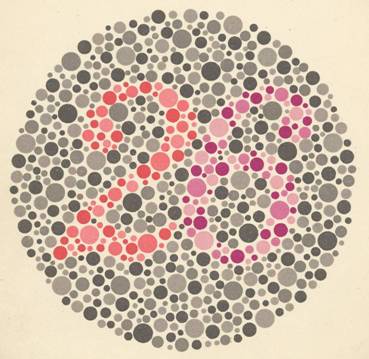
<p style="font-weight: 400;">            Color vision testing became a prominent feature of railway surgery near the end of the nineteenth century.  George Wilson, a professor at the University o f Edinburgh, had tested over one thousand individuals in various occupations in 1854, and found 5.6 percent to be colorblind, challenging the widespread belief that colorblindness was an exceedingly rare condition.  He warned of the dangers this posed to rail and sea transportation, but his concerns went unheeded as officials smugly assumed that a colorblind engineer or signalman would perform poorly and soon be discovered or fired.  Such complacency halted in 1875, when a serious railway accident in Sweden, attributed to a colorblind employee misreading a signal, drew widespread public attention.  Swedish professor Dr. Frithiof Holmgren developed a method to test color vision and applied to the entire staff of the railway line.  Dr. Holmgren surprised officials by finding 4.8 percent to be colorblind—including many successful senior employees.  Swedish officials promptly  enacted laws requiring railway employees to pass tests for color vision prior to employment<a name="_ednref42"></a><a href="http://railwaysurgery.org/HistoryLong.htm#_edn42">[42]</a>.  In the U.S., only a few states passed laws on vision testing, but many railway officials took action.  Ophthalmologist Dr. John Weeks reported in 1894 that some two-thirds of the railroads serving New York City had voluntarily adopted such programs<a name="_ednref43"></a><a href="http://railwaysurgery.org/HistoryLong.htm#_edn43">[43]</a>. </p>
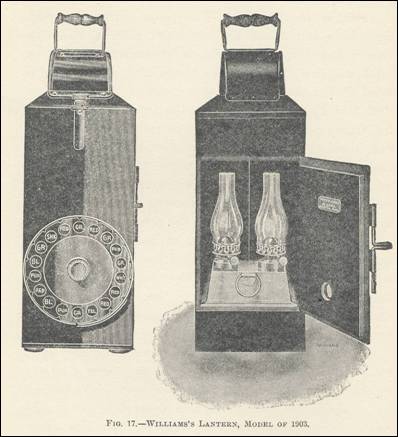
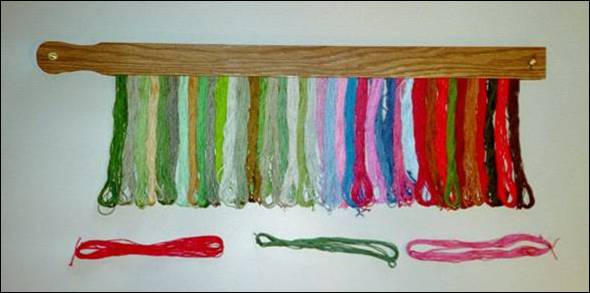
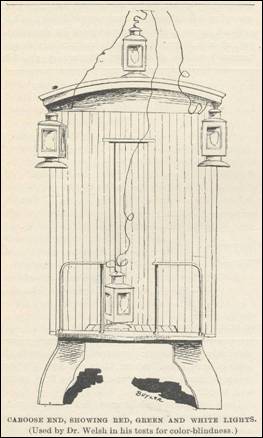
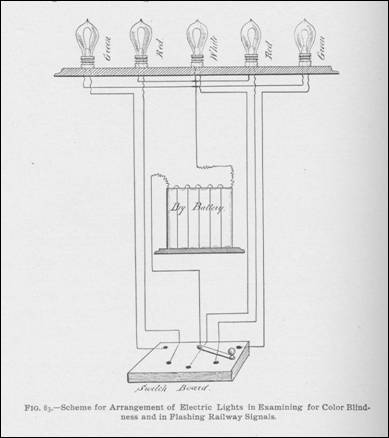
<p style="font-weight: 400;">          Dr. Holmgren’s test required subjects to match colors among 150 objects such as squares of colored paper or skeins of yarn.  Other physicians developed many elaborate testing methods, often using colored lights or flags to simulate railroad working conditions.  Some doctors even built full-size mockups of caboose ends in their offices, testing workers with colored lanterns hanging on the false car.<a name="_ednref44"></a><a href="http://railwaysurgery.org/HistoryLong.htm#_edn44">[44]</a>  However, a railroad planning to test its entire workforce needed a method that was inexpensive, portable and fast, and did not require a physician to examine every single employee.  When the Pennsylvania Railroad initiated system-wide color vision testing in 1880, officials commisioned Dr. William Thomson to develop such a solution.  Dr. Thomson simplified Dr. Holmgren’s test into a set of 40 standardized, numbered skeins of colored yarn attached to ruler-like board, which became known as Thomson’s Stick.  To perform the test, the examiner handed the subject a sample of yarn and asked him to choose from the stick other yarns similar in color.  The examiner recorded the numbers of the colors the subject chose.  Railroad supervisors could administer the test after minimal training, and each test required only two to three minutes.  Only the odd-numbered skeins represented correct choices, and the railroad allowed the examiner to pass anyone who chose only these.   However, the examiner could not fail those who selected even-numbered colors; instead, he referred them to the railway surgeon for further evaluation.  This allowed the railway doctors to focus on the small number of employees with questionable results, without having to spend time examining the vast majority who had normal color vision.   The railway surgeon could tell which colors the employee had chosen by reviewing the numbers on the test record, often making a preliminary diagnosis even before seeing the employee.  Initial tests on the Pennsylvania showed 4.2 percent of employees to have color vision defects, similar to findings in Eurpoean studies<a name="_ednref45"></a><a href="http://railwaysurgery.org/HistoryLong.htm#_edn45">[45]</a>.</p>
<p style="font-weight: 400;">            The Pennsylvania, as with other railroads, also tested visual acuity (sharpness), using the familiar Snellen chart with a large “E” at the top followed by rows of progressively smaller letters.  The railroad tested hearing using a pocket watch.  Employees who could hear the watch ticking from five feet passed the test<a name="_ednref46"></a><a href="http://railwaysurgery.org/HistoryLong.htm#_edn46">[46]</a>.  These primitive tests had many shortcomings, but they formed one of the earliest attempts to use medical screening as means to enhance workplace safety, and one of the first applications of large-scale health screening using a standardized test administered by trained, non-medical personnel.    Such techniques find widespread application today, as in the hearing tests given in elementary schools, or visual acuity and color vision tests administered in drivers’ licensing offices--the direct descendent of railroad vision testing.  (For more information, see <a href="http://railwaysurgery.org/Vision.htm">Testing Vision and Hearing</a>.)</p>
<h1>The Doctor as Claim Adjuster</h1>
<p style="font-weight: 400;">            Railway surgeons examined injured persons filing claims or lawsuits against the railroads.  The surgeon’s assessment of the degree of disability, or the validity of the injuries claimed, could have a significant impact on the amount of money awarded--or not awarded.  This arrangement created an awkward conflict of interest, and whether the doctors worked for the best interests of the patient or the company became a topic of heated debate.  </p>
<p style="font-weight: 400;">            The surgeons themselves struggled with this issue, as shown by the dozens of articles in <em>The Railway Surgeon </em>addressing the management of these delicate situations.  Dr. Herrick’s textbook devoted a full chapter to medical jurisprudence.    Dr. E. R. Lewis, a nineteenth-century expert on injury cases, offered this advice at the NARS annual meeting:  “We stand midway between the necessary extremes of this case; we have a double duty to perform; the path is straight--an honest representation of facts, regardless of results, must characterize our words and actions, and when we establish such reputations, we must and will acquire the confidence of both extremes, and the mammoth exaggerations often indulged in on both sides will fade from sight, right not might will triumph and equity will decide rather than the sympathy of a jury or the ambrosial curls of the lawyer<a name="_ednref47"></a><a href="http://railwaysurgery.org/HistoryLong.htm#_edn47">[47]</a>.”     </p>
<p style="font-weight: 400;">          The physicians vigorously defended their integrity, citing the objective nature of scientific inquiry in which they were trained.  They denied receiving any encouragement from the railways to favor the company in their reports.  Dr. Lewis told the 1893 Pan-American Medical Congress that “. . .no railroad company with which I am at all familiar desires anything but the truth, and only fears deceit and falsehood, and of all other employees they fear deceit and falsehood most in the medical and legal departments, and feeling that they have in their employ a doctor whose character can be impeached, cannot soon enough discontinue his services<a name="_ednref48"></a><a href="http://railwaysurgery.org/HistoryLong.htm#_edn48">[48]</a>.”   With even more flourish, C.A. Smith, M.D., president of the Southwestern Association of Railway Surgeons, quoted a colleague, Dr. D.R. Wallace:</p>
<blockquote>
<p style="font-weight: 400;">“I do not believe that there is a railway management from Atlantic sands to Pacific slopes, from lake to gulf, but is perfectly willing to do fullest justice to anyone, however low or obscure, having a just claim against their road.  I do not believe there is a railway surgeon in all this big land of ours who would do an act or utter a word to defraud an honest claimant out of one cent due from the railroad.  I challenge all comers to show an instance in which a railroad management, from the time an engine first awakened echoes amidst the solitudes of this great continent, up to this good hour, has refused or showed the least disposition to refuse the payment of any claim shown by the evidence to be just and right.  I challenge all comers to name the railway surgeon who has attempted in his evidence before the courts to deprive an honest claimant of a dollar<a name="_ednref49"></a><a href="http://railwaysurgery.org/HistoryLong.htm#_edn49">[49]</a>. . .”</p>
</blockquote>
<p style="font-weight: 400;">Smith continued:</p>
<blockquote>
<p style="font-weight: 400;">In some twelve years’ experience of railway surgery and personal injury litigation of railways, I have never known an instance where a railway official has tried to influence the testimony of medical witnesses and I regard all intimation and charges to that effect as calumnies, both to the managers of our railroads and as honorable a body of medical men as can be found in the country<a name="_ednref50"></a><a href="http://railwaysurgery.org/HistoryLong.htm#_edn50">[50]</a>.</p>
</blockquote>
<p style="font-weight: 400;">Decades later, retired Florida East Coast Railway chief surgeon Vernon Lockwood, M.D., reflecting on the countless days he spent testifying in court cases, said simply that “[t]he railway never asked me to favor it in testimony<a name="_ednref51"></a><a href="http://railwaysurgery.org/HistoryLong.htm#_edn51">[51]</a>.”  Despite such assurances, the issue haunted the specialty until changes in laws allowed injury victims to choose their own physicians for medical care and as expert witnesses.  </p>
<h1>The Railroad Hospital and Hospital Association</h1>
<p style="font-weight: 400;">          The western railroads traversed rural areas and fresh new settlements devoid of any substantial health care infrastructure.  Dr. Outten noted that a person traveling between St. Louis and El Paso would go over 1300 miles without passing a single hospital<a name="_ednref52"></a><a href="http://railwaysurgery.org/HistoryLong.htm#_edn52">[52]</a>.  The Central Pacific Railroad, under the direction of vice-president A. M. Towne, responded by opening its own hospital in Sacramento in 1869<a name="_ednref53"></a><a href="http://railwaysurgery.org/HistoryLong.htm#_edn53">[53]</a>.  This institution, which most historians recognize as the first exclusive railroad hospital, served as a driving force for other railroads to develop their own facilities, and many more hospitals quickly appeared along the western rail lines.  The Sacramento hospital remained in operation until 1899, when Central Pacific successor Southern Pacific relocated it to the company’s headquarters city of San Francisco<a name="_ednref54"></a><a href="http://railwaysurgery.org/HistoryLong.htm#_edn54">[54]</a>.</p>
<p style="font-weight: 400;">            Eastern railroads passed through older, well-developed cities, and these railroads initially contracted with the existing hospitals rather than spending large sums of capital building their own institutions.  Twenty-five years after the Central Pacific Hospital opened, the Illinois Central and the Pennsylvania Railroad still did not have their own medical facilities<a name="_ednref55"></a><a href="http://railwaysurgery.org/HistoryLong.htm#_edn55">[55]</a>.  Nonetheless, the railroad-owned hospitals afforded convenience, control and the economies of scale and consolidation--benefits the eastern lines ultimately could not ignore.  NARS president Dr. C.W.P. Brock of Virginia said in his address to the annual meeting:</p>
<blockquote>
<p style="font-weight: 400;">            The railway hospital plan is another admirable western product; and we of the east are glad to sit at the feet of these western Gamaliels and learn of them how to do these great things.  [Author’s note:  Gamaliel was a member of the Sanhedrin and a highly respected teacher of the law, who taught St. Paul (Acts 5:34-39; Acts 22:3).]</p>
<p style="font-weight: 400;">            Mr. Greeley’s advice to the young man to “go west” may be followed with great benefit by railway surgeons from the older sections of our country; and when they have seen the superb hospitals and the practical workings of the system they will say, as the Queen of Sheba said after seeing the splendors of King Solomon, “that the half had not been told.”<a name="_ednref56"></a><a href="http://railwaysurgery.org/HistoryLong.htm#_edn56">[56]</a></p>
</blockquote>
<p style="font-weight: 400;">          Sounding a more pragmatic note, the Long Island surgeon Dr. Chaffee<a name="_ftnref6"></a> <a href="http://railwaysurgery.org/HistoryLong.htm#_ftn6">(e)</a> estimated that that the daily cost per patient at a railway hospital ran from 40 to 60 cents, compared to $1.00 to $1.50 at a city or contract hospital.  “The relief and hospital department is a straight business proposition or transaction, founded upon business principles,” he declared<a name="_ednref57"></a><a href="http://railwaysurgery.org/HistoryLong.htm#_edn57">[57]</a>. <strong> </strong>Railroad companies also hoped that providing generous benefits at company hospitals would foster goodwill, helping decrease injury-related lawsuits.  “Comparing the suits for damages reported by the claim agents of the various companies at their meetings, the difference between the companies having the hospital system, and those not having such a system is simply astounding, and is all in favor of the highest class of surgical service,<a name="_ednref58"></a><a href="http://railwaysurgery.org/HistoryLong.htm#_edn58">[58]</a>” Dr. Reed observed.  Historian Mark Aldrich noted that workers also benefited from a system that avoided lawsuits:  employees who sued risked losing their jobs, and most won only small judgements after long delays<a name="_ednref59"></a><a href="http://railwaysurgery.org/HistoryLong.htm#_edn59">[59]</a>.  By 1896, 13 railroads operated 25 hospitals, treating over 165,000 patients annually.<a name="_ednref60"></a><a href="http://railwaysurgery.org/HistoryLong.htm#_edn60">[60]</a> Even a pragmatist such as Dr. Chaffee could not hide his enthusiasm with this growth.  “The sun of railway surgery and of the hospital system rose in the West, but its brilliant light is rapidly breaking over the East<a name="_ednref61"></a><a href="http://railwaysurgery.org/HistoryLong.htm#_edn61">[61]</a>,” he told a NARS assembly.</p>
<p style="font-weight: 400;">            Railroads retained private physicians under contract in cities along their lines.  Known as “local surgeons,” they were on call at all times to provide initial care at any railroad-related emergency.  The railroad paid for this treatment regardless of whether the injured was an employee, passenger, bystander or hobo.  If the patient required further care, the local surgeon arranged transfer to another doctor or hospital, referring non-employees to a local hospital, at the patient’s expense, or to a charity hospital, if available.  Railroad employees received complimentary rail transport to the nearest company hospital, with ambulance transfers to and from the stations, if needed.  Only if the patient’s condition rendered transport unsafe would the railway pay for an employee’s care at an outside hospital; even then, the company expected the patient to transfer to the nearest railroad hospital as soon as his or her medical condition allowed it<a name="_ftnref7"></a> <a href="http://railwaysurgery.org/HistoryLong.htm#_ftn7">(f)</a>. </p>
<p style="font-weight: 400;">            Railroad hospitals ranged from small facilities resembling private homes to large medical centers such as the 300-bed Illinois Central Hospital in Chicago or the 450-bed Southern Pacific Hospital in San Francisco.  The industry reached a peak of 35 railroad hospitals throughout the country, providing a total of 3700 beds<a name="_ednref62"></a><a href="http://railwaysurgery.org/HistoryLong.htm#_edn62">[62]</a> (see appendix).  The larger ones offered a full range of services, including consultants from various medical specialties, and facilities and equipment that compared favorably with the top private and government hospitals of their day.  The Santa Fe Hospital in Topeka, which opened in 1896, boasted such innovative features as forced air ventilation with a full air exchange every 10 to 12 minutes, and independent heat control in each ward or room<a name="_ednref63"></a><a href="http://railwaysurgery.org/HistoryLong.htm#_edn63">[63]</a>.  The Southern Pacific’s San Francisco hospital became the second hospital in the nation to open an intensive care unit<a name="_ednref64"></a><a href="http://railwaysurgery.org/HistoryLong.htm#_edn64">[64]</a>.  Many of these hospitals operated nursing schools, internships, and residency training programs.  Some even manufactured pharmaceuticals<a name="_ednref65"></a><a href="http://railwaysurgery.org/HistoryLong.htm#_edn65">[65]</a> or raised their own farm products<a name="_ftnref8"></a> (g)<a name="_ednref66"></a> <a href="http://railwaysurgery.org/HistoryLong.htm#_edn66">[66]</a>.  The railroads also maintained many more “emergency hospitals,” usually located on the grounds of major yards or service facilities.  These were not true hospitals, but rather minor emergency clinics, typically housed in a one-room building and staffed by a single doctor and nurse. </p>
<p style="font-weight: 400;">            Descriptions of railway hospitals frequently mentioned efforts to create a relaxing environment for patients.  Dr. Outten suggested that the camaraderie at a railroad hospital offered therapeutic value in itself.  “Railway men are naturally clannish,” he said, “and they take pride in direct contact and in discussing the diverse experiences of their vocation; and it is in the nature of a curative measure for railway men to have their surroundings thoroughly railroadish, and. . .  the homelike element is the one which satisfies the railroad man<a name="_ednref67"></a><a href="http://railwaysurgery.org/HistoryLong.htm#_edn67">[67]</a>”.  The Missouri Pacific Railroad Hospital at St. Louis, which opened in 1884, provided musical instruments and a patient library with over 2800 volumes<a name="_ednref68"></a><a href="http://railwaysurgery.org/HistoryLong.htm#_edn68">[68]</a>.  “Every effort is made to serve the mind as well as the body,” noted a reporter<a name="_ednref69"></a><a href="http://railwaysurgery.org/HistoryLong.htm#_edn69">[69]</a>.</p>
<p style="font-weight: 400;">              Railroad hospitals initially accepted only railroad employees.  However, the lack of alternative facilities led hospitals in some areas to open their doors to the public.  The Alaska Railroad Hospital in Anchorage, for example, maintained by far the best facilities and equipment in the area when it opened in 1916.  The hospital accepted non-railroad patients until Providence Hospital opened in 1939.  The U.S. Army also used the Alaska Railroad Hospital at the beginning of World War II during the construction of the Army’s own facilities<a name="_ednref70"></a><a href="http://railwaysurgery.org/HistoryLong.htm#_edn70">[70]</a>.  Eventually, many railroad hospitals accepted private patients to help fill unused capacity and generate revenue to reduce employee charges.  Private patients paid higher fees, as the company did not subsidize their care.</p>
<p style="font-weight: 400;">            The Florida East Coast Railway Hospital in St. Augustine provides an example of a large, busy railroad hospital.  Operating from 1906 to 1963, at its peak it maintained 112 beds and provided all types of medical and surgical care, as well as a nurse-training program.  Most patients stayed in large wards with 10-15 beds, following the standard practice of the time.  In 1930 a hospital ward bed cost railroad employees $3 a day, which included all medications, tests and x-rays.  Major operations cost $75-150 and infant deliveries cost $35-50.   The hospital accumulated a budget deficit each year, which the railway absorbed<a name="_ednref71"></a><a href="http://railwaysurgery.org/HistoryLong.htm#_edn71">[71]</a>.</p>
<p style="font-weight: 400;">            Some railroads even operated long-term care facilities.  The Southern Pacific maintained a tuberculosis sanitarium in a converted freight station in Tucson<a name="_ednref72"></a><a href="http://railwaysurgery.org/HistoryLong.htm#_edn72">[72]</a>, allowing patients with “consumption” to enjoy the only known treatment for the dreaded disease:  a mild climate, rest and fresh air.  The Santa Fe Coast Lines Hospital in Los Angeles also accepted tuberculosis patients, housing them in tents on the hospital grounds.  A contemporary account notes that the tents were “heated, lighted, and furnished for [their] comfort<a name="_ednref73"></a><a href="http://railwaysurgery.org/HistoryLong.htm#_edn73">[73]</a>.”  The belief that certain climates afforded therapeutic benefits led some doctors of the time to call for a patient-exchange system between regional railroads, such as that proposed by Dr. Chaffee:</p>
<blockquote>
<p style="font-weight: 400;">Patients recovering from pneumonia, la grippe, rheumatism and other diseases of this class would be taken from the North to the sunny South.  Typhoid, malarial and swamp fever cases would be sent North or to non-malarial sections of the country.  The unfortunate consumptive would seek the West and Southwest, where he might not only find relief, but in time, employment. . .[I]t will be found to repay a thousand fold for any effort it may cost.  Only the best is good enough for our faithful railway men.<a name="_ednref74"></a><a href="http://railwaysurgery.org/HistoryLong.htm#_edn74">[74]</a>  [Author’s note:  “La grippe” is influenza.]</p>
</blockquote>
<p style="font-weight: 400;"> If such a program were ever instituted, it was not recorded.</p>
<p style="font-weight: 400;">            The property, buildings and furnishings of a railroad hospital counted as fully taxable assets of the company.  Many railroads opted to relieve themselves of a significant tax burden by creating independent foundations to own and operate the hospitals and health plans.  These foundations, known as employee hospital associations (EHAs), also benefited the employees by allowing them more representation in hospital management.  The board of directors of an EHA hospital consisted of railway employees from a variety of occupations, typically one from each of the many unions representing them (<a href="http://railwaysurgery.org/HistoryLong.htm#Table4">Table 4</a>).  This stood in contrast to the company-owned hospitals, which were managed primarily by corporate officers.  Many EHAs chose a non-profit organizational structure, conferring tax benefits and the ability to solicit donations and grants.   Funding for the hospitals and health plans managed by EHAs remained essentially unchanged:  payroll deductions, patient fees, and corporate subsidies. </p>
<p style="font-weight: 400;">            The EHAs published books of regulations, which bear a striking resemblance in principle to late twentieth-century managed-care handbooks.  Members could use only designated hospitals and physicians; certain types of care, as well as outside consultations, required advance approval from the chief surgeon.  Many benefits carried specific limits on the cost or quantity of goods and services provided.  One handbook states that diabetic patients taking insulin would receive not more than one syringe and two needles<a name="_ednref75"></a><a href="http://railwaysurgery.org/HistoryLong.htm#_edn75">[75]</a>; another provides for the loan of crutches, with the patient to be billed if they were not returned<a name="_ednref76"></a><a href="http://railwaysurgery.org/HistoryLong.htm#_edn76">[76]</a>.  The strict limits on utilization and the centralized approval process, although very familiar to the modern managed-care consumer, represented radical concepts at the time of their introduction.  They challenged the traditional view of the independent private physician as an unquestionable authority.  Yet the techniques proved highly effective in keeping costs under control, setting an example that would resurface decades after the EHAs disappeared.</p>
<p style="font-weight: 400;">            The EHA regulations also reflected the social and moral sentiments of their times, often appearing harsh and judgmental by modern standards.  A booklet of Union Pacific Railroad EHA regulations, for example, notes that no benefits were provided for pregnancy, venereal diseases, injuries received in a fight, ailments resulting from “vicious habits”, attempted suicide, or “any sickness or injury directly due to or contributed to in any way by alcoholic intoxication.”  The booklet even notes that blood transfusions were covered, but recipients would be expected to provide donors to replace the blood they used<a name="_ednref77"></a><a href="http://railwaysurgery.org/HistoryLong.htm#_edn77">[77]</a>.</p>
<h1>Twilight of the Profession</h1>
<p style="font-weight: 400;">            Railway surgery fell into decline early in the twentieth century.  By 1920, <em>The Railway Surgeon</em> (renamed <em>The Railway Surgical Journal</em>), only published 44 manuscripts; within a year, the word ‘railway’ vanished as the journal changed its name to <em>The Surgical Journal Devoted to Traumatic and Industrial Surgery</em>.  NARS had become inactive and ceased its grand annual meetings<a name="_ednref78"></a><a href="http://railwaysurgery.org/HistoryLong.htm#_edn78">[78]</a>.   Several factors contributed to the demise of the system.  Many patients did not like being required to see designated physicians, and wanted to see doctors of their choice in their communities, especially if one lived far from a railroad hospital.  Private insurance policies, prior to the 1980s, offered a wide range of choices with few restrictions.  Railroad employees, through their unions, pressed for contracts with these policies in place of the restrictive railroad doctor-hospital system.  Injury victims frequently asked for doctors not affiliated with the railroad.  Changes in government regulations, the creation of Medicaid and Medicare<a name="_ftnref10"></a> <a href="http://railwaysurgery.org/HistoryLong.htm#_ftn10">(h)</a>, and booming medical advances in the 1950s and 1960s also made the management of health care facilities progressively more complicated and expensive.  Finally, the railroads sought to divest money-losing auxiliary enterprises.  As the last railroad hospitals were sold or closed in the early 1970s, the remaining railway surgeons dispersed, setting up private offices or joining other practices, although many continued to see their previous patients in the new settings.</p>
<p style="font-weight: 400;">            Some of the railroad hospitals continued to operate as independent hospitals, such as the Santa Fe Hospital in Temple, Texas, which grew into the Scott and White regional healthcare network—still offering a prepaid health plan similar to the railroad plans.  The Illinois Central Hospital became a private institution, Doctors Hospital of Hyde Park, and remained open until a Medicare fraud scandal sent it into bankruptcy in 2000<a name="_ednref79"></a><a href="http://railwaysurgery.org/HistoryLong.htm#_edn79">[79]</a>. Some communities found new uses for the railway hospitals.  A San Francisco group converted the Southern Pacific Hospital to housing, while the Houston location, the “Sunset Hospital,” ultimately became a county clinic.   Many hospitals were demolished.  <em>(See <a href="http://railwaysurgery.org/List.htm">list of railway hospitals</a> for status of facilities, if known.)</em></p>
<h1>The Legacy of the Railway Surgeons</h1>
<p style="font-weight: 400;">            Railway surgeons left a lasting impact on the science of medicine.  Through their research, associations and publications, they created the first modern and systematic study of trauma and its treatment. Dr. Rutkow observed:</p>
<blockquote>
<p style="font-weight: 400;">                Modern trauma surgeons owe gratitude to railway surgeons because they provided the first known instances of organized traumatology.  Through their textbooks and journal writings, it is apparent that the concept of trauma surgery as a form of specialized surgery was an important part of the railway surgeon’s crusade for better health care in our society<a name="_ednref80"></a><a href="http://railwaysurgery.org/HistoryLong.htm#_edn80">[80]</a>.</p>
</blockquote>
<p style="font-weight: 400;">They helped shape the modern medical world with their pioneering contributions in prehospital care, emergency medical transport, wound care, mass health screening and first aid kits.  The surgeons called attention to public safety and sanitation issues, and set the stage for the modern specialty of occupational medicine.   Their journal, <em>The</em> <em>Railway Surgeon,</em> underwent several mergers and name changes, but its descendent remains in print today, under the name <em>Occupational Health and Safety</em><a name="_ednref81"></a><a href="http://railwaysurgery.org/HistoryLong.htm#_edn81">[81]</a><em>.</em> </p>
<p style="font-weight: 400;">            The railway surgeons also became a powerful force in shaping the social aspects of medicine.  Through the railroad hospitals and hospital associations, they sought to provide comprehensive health care to large numbers of people in an economical and efficient manner--a lofty and difficult goal even today.  They met the challenge by creating revolutionary managerial and financing models, pioneering the prepaid health plan and the vertically integrated healthcare network—leaving a lasting contribution for future generations.</p>
<p style="font-weight: 400;"><em>Please visit the <a href="http://railwaysurgery.org/Gallery.htm">Image Gallery</a> and other areas of this site to learn more about railway surgeons.</em></p>
<h1>Tables</h1>
<h3 style="font-weight: 400;"><strong>Table 1:  Monthly assessments for the hospital fund, Atchison, Topeka and Santa Fe Railway, 1894</strong></h3>
<p style="font-weight: 400;">Monthly gross earnings    Monthly hospital fund assessment</p>
<p style="font-weight: 400;">$30 or less                                           $0.25</p>
<p style="font-weight: 400;">More than $30 and less than $60          0.35</p>
<p style="font-weight: 400;">$60 and less than $100                         0.50</p>
<p style="font-weight: 400;">$100 or over                                        1.00</p>
<p style="font-weight: 400;">Source:  Rules and regulations of the A.T.&amp;S.F. Hospital Association.  <em>The Railway Surgeon </em>1894; 1(3): 70.</p>
<h3 style="font-weight: 400;"><strong>Table 2:  Sites of early NARS annual meetings</strong></h3>
<p style="font-weight: 400;">St. Louis, Mo.</p>
<p style="font-weight: 400;">Kansas City, Mo.</p>
<p style="font-weight: 400;">Buffalo, N.Y.</p>
<p style="font-weight: 400;">Old Point Comfort, Va.</p>
<p style="font-weight: 400;">Omaha, Neb.</p>
<p style="font-weight: 400;">Galveston, Tex.</p>
<p style="font-weight: 400;">Chicago, Ill.</p>
<p style="font-weight: 400;">St. Louis, Mo.</p>
<p style="font-weight: 400;">Chicago, Ill.</p>
<p style="font-weight: 400;">Source:  A bit of history.<em>  The Daily Railway Surgeon</em> 1897;3(25):8.</p>
<h3 style="font-weight: 400;"><strong>Table 3:  Selected exhibitors at the Tenth Annual Convention of the National Association of Railway Surgeons, Chicago, Illinois, May 1897</strong></h3>
<p style="font-weight: 400;">Johnson &amp; Johnson</p>
<p style="font-weight: 400;">Eli Lilly &amp; Co.</p>
<p style="font-weight: 400;">McKessin &amp; Robbins</p>
<p style="font-weight: 400;">Parke, Davis &amp; Co.</p>
<p style="font-weight: 400;">Pasteur Vaccine Company</p>
<p style="font-weight: 400;">Searle &amp; Hereth</p>
<p style="font-weight: 400;">Source:  The Exhibits. <em> The Daily Railway Surgeon</em> 1897;3(25):13-14.</p>
<h3 style="font-weight: 400;"><strong>Table 4:  Board of Trustees of the Missouri-Kansas-Texas Railroad Employes’ Hospital Association</strong></h3>
<p style="font-weight: 400;">One trustee is selected from each of the following organizations:</p>
<ul style="list-style-type: square;">
<li style="font-weight: 400;">Conductors</li>
<li style="font-weight: 400;">Brakemen, switchmen and other trainmen</li>
<li style="font-weight: 400;">Engineers</li>
<li style="font-weight: 400;">Firemen</li>
<li style="font-weight: 400;">Station agents, telegraphers, levermen and linemen</li>
<li style="font-weight: 400;">Metal crafts and car department workers</li>
<li style="font-weight: 400;">Bridge, building, construction and trackmen</li>
<li style="font-weight: 400;">Clerks, general office, store and station employes</li>
<li style="font-weight: 400;">Signal men</li>
<li style="font-weight: 400;">Supervisory officers</li>
</ul>
<p style="font-weight: 400;">Source:  <em>Missouri-Kansas-Texas Railroad Employes’ Hospital Association Charter, By-Laws and Rules and Regulations</em>, 1950.</p>
<h1>Footnotes</h1>
<p><a name="_ftn1"></a><a href="http://railwaysurgery.org/HistoryLong.htm#_ftnref1">(a)</a> Inexplicably, the railroads did not offer free travel to the second Pan American Medical Congress, held in Mexico City in 1896.  The doctors chartered a train from Chicago for the five-day journey over eight railroads.  “A splendid train of palace sleeping and dining cars is being specially prepared,” proclaimed one announcement.  A round trip fare of $190.10 covered “every necessary expense of the trip of twenty-one days,” including the option of using the parked train as one’s lodging during the convention.  (Report on transportation for the second Pan American Medical Congress.  <em>The Railway Surgeon</em> 1896; 3(12): 281.)</p>
<p><a name="_ftn2"></a><a href="http://railwaysurgery.org/HistoryLong.htm#_ftnref2">(b)</a> Dr. Stemen was also a member of the committee which initially organized the NARS and was elected the first secretary of the organization.</p>
<p><a name="_ftn3"></a><a href="http://railwaysurgery.org/HistoryLong.htm#_ftnref3">(c)</a>The “new” name actually returned the organization to its roots, as the “American Association of Railway Surgeons” was precisely the name Dr. Ridenour had specified in his 1887 resolution which led to the formation of NARS (A bit of history.  <em>The Daily Railway Surgeon</em> 1897; 3(25):7-8.)</p>
<p><a name="_ftn4"></a><a href="http://railwaysurgery.org/HistoryLong.htm#_ftnref4">(d)</a> For one thorough period review of anesthesia techniques, see:  McGannon, E.A.  Anaesthesia, local and general [paper read before the seventh annual meeting of the National Association of Railway Surgeons, Galveston, Tex., May 8-11, 1894.]  <em>The Railway Surgeon</em> 1894; 1(9): 206-215.</p>
<p><a name="_ftn6"></a><a href="http://railwaysurgery.org/HistoryLong.htm#_ftnref6">(e)</a> Dr. Chaffee also founded the New York State Association of Railway Surgeons.</p>
<p><a name="_ftn7"></a><a href="http://railwaysurgery.org/HistoryLong.htm#_ftnref7">(f)</a> A typical policy is described in the <em>Frisco Employes’ Hospital Association by-laws and rules and regulations</em>, 1962, p. 18-21.</p>
<p><a name="_ftn8"></a><a href="http://railwaysurgery.org/HistoryLong.htm#_ftnref8">(g)</a> A period observer of the Santa Fe Coast Lines Hospital noted that “the hospital has its own Jersey cows, a nice flock of chickens and well cultivated gardens, so that patients may be assured of the freshest milk, butter, eggs, poultry and vegetables.” (The Santa Fe Coast Lines Hospital Association.  In: <em>Meade’s Manual</em>.  http://www.atsfry.com/EasternArchive/ eades/coasthos.htm.  Accessed November 27, 2001.)</p>
<p><a name="_ftn10"></a><a href="http://railwaysurgery.org/HistoryLong.htm#_ftnref10">(h)</a> Railroad hospitals tallied another “first” when the first Medicare check to a hospital was sent to the Southern Pacific Hospital in San Francisco (Short, Henry J.  <em>Railroad doctors, hospitals and associations:  pioneers in comprehensive low cost medical care</em>.  Lakeport, Cal.:  Shearer/Graphic Arts, 1986).</p>
<h1><br>Works Cited</h1>
<p> </p>
<p><a name="_edn1"></a><a href="http://railwaysurgery.org/HistoryLong.htm#_ednref1">[1]</a> Rutkow, Ira.  Railway surgery:  traumatology and managed health care in 19th-century United States.  <em>Arch Surg</em> 1993;128(4):458-63. </p>
<p><a name="_edn2"></a><a href="http://railwaysurgery.org/HistoryLong.htm#_ednref2">[2]</a> Rules and Regulations of the A. T. &amp; S. F. Hospital Association.  <em>The Railway Surgeon</em> 1894;1(3):70.</p>
<p><a name="_edn3"></a><a href="http://railwaysurgery.org/HistoryLong.htm#_ednref3">[3]</a> Rutkow. </p>
<p><a name="_edn4"></a><a href="http://railwaysurgery.org/HistoryLong.htm#_ednref4">[4]</a> Chaffee, George.  The railway employes’ hospital association [paper read at ninth annual meeting of National Association of Railway Surgeons, St. Louis, May 1986.]  <em>The Railway Surgeon</em> 1896;3(9):193-7.</p>
<p><a name="_edn5"></a><a href="http://railwaysurgery.org/HistoryLong.htm#_ednref5">[5]</a>Reed, R. Harvey.  Quoted in discussion following Caldwell, Frank H.  The railway hospital--its necessity and benefits [paper read before the third annual meeting of the New York State Association of Railway Surgeons, New York City].  <em>The Railway Surgeon</em> 1894;1(1): 2-7.   </p>
<p><a name="_edn6"></a><a href="http://railwaysurgery.org/HistoryLong.htm#_ednref6">[6]</a> Chaffee, George.  A review of the relief and hospital department [paper read before the Annual Meeting of the Section on Railway Surgery, of the Medico-Legal Society of New York City, Dec. 16, 1896].  <em>The Railway Surgeon</em>1897;3(18): 422-4.</p>
<p><a name="_edn7"></a><a href="http://railwaysurgery.org/HistoryLong.htm#_ednref7">[7]</a>Lewis, Eugene R. The evolution of railway surgery.  <em>The Railway Surgeon</em> 1894;1(10):227-231.</p>
<p><a name="_edn8"></a><a href="http://railwaysurgery.org/HistoryLong.htm#_ednref8">[8]</a> Rutkow.</p>
<p><a name="_edn9"></a><a href="http://railwaysurgery.org/HistoryLong.htm#_ednref9">[9]</a> Stemen, Christian B.  <em>Railway Surgery:  A Practical Work on the Special Department of Railway Surgery, for Railway Surgeons and Practitioners in the General Practice of Surgery</em>.  St. Louis, Mo.:  J.H. Chambers &amp; Co., 1890: v; also noted in Rutkow.</p>
<p><a name="_edn10"></a><a href="http://railwaysurgery.org/HistoryLong.htm#_ednref10">[10]</a> A bit of history.  <em>The Daily Railway Surgeon</em> 1897;3(25):7-8.</p>
<p><a name="_edn11"></a><a href="http://railwaysurgery.org/HistoryLong.htm#_ednref11">[11]</a> Reed, R. Harvey.  Treasurer’s annual report. In Reed R. Harvey, ed.  The National Association of Railway Surgeons official report of the sixth annual meeting held at Omaha, Nebraska May 31, June 1 and 2, 1893.  Chicago:  The Railway Age and Northwestern Railroader, 1893: 25.</p>
<p><a name="_edn12"></a><a href="http://railwaysurgery.org/HistoryLong.htm#_ednref12">[12]</a> Caldwell, Frank H.  The railway hospital--its necessity and benefits [paper read before the third annual meeting of the New York State Association of Railway Surgeons, New York City].  <em>The Railway Surgeon</em> 1894;1(1):2-7.</p>
<p><a name="_edn13"></a><a href="http://railwaysurgery.org/HistoryLong.htm#_ednref13">[13]</a> The Exhibits.  <em>The Daily Railway Surgeon</em> 1897;3(25):13-14.</p>
<p><a name="_edn14"></a><a href="http://railwaysurgery.org/HistoryLong.htm#_ednref14">[14]</a> About Transportation.  <em>The Railway Surgeon</em> 1897;3(23): 546-548.</p>
<p><a name="_edn15"></a><a href="http://railwaysurgery.org/HistoryLong.htm#_ednref15">[15]</a> The Annual Meeting.  <em>The Railway Surgeon</em> 1895;4(9):55.</p>
<p><a name="_edn16"></a><a href="http://railwaysurgery.org/HistoryLong.htm#_ednref16">[16]</a> Second day--morning session.  In Reed R. Harvey, ed.  <em>The National Association of Railway Surgeons official report of the sixth annual meeting held at Omaha, Nebraska May 31, June 1 and 2, 1893</em>.  Chicago:  The Railway Age and Northwestern Railroader, 1893: 22.</p>
<p><a name="_edn17"></a><a href="http://railwaysurgery.org/HistoryLong.htm#_ednref17">[17]</a> Brock, C.W.P.  President’s Address.  In Reed RH, ed.  <em>The National Association of Railway Surgeons official report of the sixth annual meeting held at Omaha, Nebraska May 31, June 1 and 2, 1893</em>.  Chicago:  The Railway Age and Northwestern Railroader, 1893: 10-16.</p>
<p><a name="_edn18"></a><a href="http://railwaysurgery.org/HistoryLong.htm#_ednref18">[18]</a> Lewis, Eugene R.  Railway surgery as a branch of the science and art of surgery [paper read before the Railway Section of the First Pan-American Medical Congress, Washington, D.C., Sept. 7, 1893].  <em>The Railway Surgeon</em>1894;1(1):18-21.</p>
<p><a name="_edn19"></a><a href="http://railwaysurgery.org/HistoryLong.htm#_ednref19">[19]</a> Stemen.</p>
<p><a name="_edn20"></a><a href="http://railwaysurgery.org/HistoryLong.htm#_ednref20">[20]</a> Herrick, Clinton B.  <em>Railway Surgery:  A Handbook on the Management of Injuries</em>.  New York:  William Wood and Co., 1899.</p>
<p><a name="_edn21"></a><a href="http://railwaysurgery.org/HistoryLong.htm#_ednref21">[21]</a> Starr, Paul. <em> The Social Transformation of American Medicine</em>.  New York:  Basic Books, 1982.</p>
<p><a name="_edn22"></a><a href="http://railwaysurgery.org/HistoryLong.htm#_ednref22">[22]</a> Hemenway, Henry B.  The ethical relations of the railway surgeon  [paper read at fourth annual meeting of the Chicago, Milwaukee &amp; St. Paul Railway Surgeons’ Association, Chicago, Nov. 12-13 1896.) <em>The Railway Surgeon</em> 1897;3(21):481-486.</p>
<p><a name="_edn23"></a><a href="http://railwaysurgery.org/HistoryLong.htm#_ednref23">[23]</a> Rutkow. </p>
<p><a name="_edn24"></a><a href="http://railwaysurgery.org/HistoryLong.htm#_ednref24">[24]</a> <em>Journal of the American Medical Association</em>, May 11, 1895.  Cited in: At the end of a year.  <em>The</em> <em>Railway</em> <em>Surgeon</em> 1895;1(26); 626.</p>
<p><a name="_edn25"></a><a href="http://railwaysurgery.org/HistoryLong.htm#_ednref25">[25]</a> Our sad promiscuosity.  <em>The Railway Surgeon</em> 1894; 1(13):315.</p>
<p><a name="_edn26"></a><a href="http://railwaysurgery.org/HistoryLong.htm#_ednref26">[26]</a> Some expressions of loyalty.  <em>The Railway Surgeon</em> 1894; 1(11):266.</p>
<p><a name="_edn27"></a><a href="http://railwaysurgery.org/HistoryLong.htm#_ednref27">[27]</a> Some more expressions of loyalty.  <em>The Railway Surgeon</em> 1894;1(12):289.</p>
<p><a name="_edn28"></a><a href="http://railwaysurgery.org/HistoryLong.htm#_ednref28">[28]</a>  At the end of a year.  <em>The Railway Surgeon</em> 1895: 1(26): 626.</p>
<p><a name="_edn29"></a><a href="http://railwaysurgery.org/HistoryLong.htm#_ednref29">[29]</a>  Kepner, Raymond B.  A brief history.  <em>Industrial Medicine and Surgery </em>1963;32(9):349-50.</p>
<p><a name="_edn30"></a><a href="http://railwaysurgery.org/HistoryLong.htm#_ednref30">[30]</a> Hunt, James G.  Railway surgery [lecture delivered before the railway branch of the Y.M.C.A. at Utica, New York, February 1897].  <em>The Railway Surgeon</em> 1897;3(24):553-9.</p>
<p><a name="_edn31"></a><a href="http://railwaysurgery.org/HistoryLong.htm#_ednref31">[31]</a> Herrick.</p>
<p><a name="_edn32"></a><a href="http://railwaysurgery.org/HistoryLong.htm#_ednref32">[32]</a> Fairbrother, H.C.  The surgical emergency bag [letter].  <em>The Railway Surgeon</em> 1894;1(13):310.</p>
<p><a name="_edn33"></a><a href="http://railwaysurgery.org/HistoryLong.htm#_ednref33">[33]</a> Caldwell.</p>
<p><a name="_edn34"></a><a href="http://railwaysurgery.org/HistoryLong.htm#_ednref34">[34]</a> Fairbrother.</p>
<p><a name="_edn35"></a><a href="http://railwaysurgery.org/HistoryLong.htm#_ednref35">[35]</a> Haller, J.S.  Intolerable, excruciating and troublesome:  military ambulance technology, 1793-1880.  <em>Caduceus</em> 1971;7(2):2-30.</p>
<p><a name="_edn36"></a><a href="http://railwaysurgery.org/HistoryLong.htm#_ednref36">[36]</a>Lewis, The evolution of railway surgery. </p>
<p><a name="_edn37"></a><a href="http://railwaysurgery.org/HistoryLong.htm#_ednref37">[37]</a> Reed, R. Harvey.  Quoted in discussion following Caldwell.</p>
<p><a name="_edn38"></a><a href="http://railwaysurgery.org/HistoryLong.htm#_ednref38">[38]</a> Woodward, CM.  The responsibility of the surgeon in suits for damages against railway companies.  In Reed R. Harvey, ed.  The National Association of Railway Surgeons official report of the sixth annual meeting held at Omaha, Nebraska May 31, June 1 and 2, 1893.  Chicago:  The Railway Age and Northwestern Railroader, 1893: 231-237.</p>
<p><a name="_edn39"></a><a href="http://railwaysurgery.org/HistoryLong.htm#_ednref39">[39]</a> Herrick.</p>
<p><a name="_edn40"></a><a href="http://railwaysurgery.org/HistoryLong.htm#_ednref40">[40]</a> Notes, news and personals.  <em>The Railway Surgeon</em>.  1894; 1(13):316.</p>
<p><a name="_edn41"></a><a href="http://railwaysurgery.org/HistoryLong.htm#_ednref41">[41]</a> Cox, Mike.  Dr. Sofie:  frontier surgeon blazed a trail for other women to follow.  <em>Texas</em><em> Medicine</em> 1999; 95(9):41-3.</p>
<p><a name="_edn42"></a><a href="http://railwaysurgery.org/HistoryLong.htm#_ednref42">[42]</a> Jennings, J. Ellis.  Color-vision and color-blindness.  A practical manual for railroad surgeons.  Philadelphia, Pa.:  The F. A. Davis Co., 1897.</p>
<p><a name="_edn43"></a><a href="http://railwaysurgery.org/HistoryLong.htm#_ednref43">[43]</a> Weeks, J.E.  Ophthalmology in railway surgery.  <em>The Railway Surgeon</em> 1894 ;1(3):59.</p>
<p><a name="_edn44"></a><a href="http://railwaysurgery.org/HistoryLong.htm#_ednref44">[44]</a> Welsh, D. Emmett.  Color blindness.  <em>The Railway Surgeon</em>.  1894;1(1):8-10.</p>
<p><a name="_edn45"></a><a href="http://railwaysurgery.org/HistoryLong.htm#_ednref45">[45]</a> Jennings.</p>
<p><a name="_edn46"></a><a href="http://railwaysurgery.org/HistoryLong.htm#_ednref46">[46]</a> Jennings. </p>
<p><a name="_edn47"></a><a href="http://railwaysurgery.org/HistoryLong.htm#_ednref47">[47]</a> Lewis, E.R.  The National Association of Railway Surgeons--not a trade union, but a philanthropic and scientific organization.  In Reed R. Harvey, ed.  The National Association of Railway Surgeons official report of the sixth annual meeting held at Omaha, Nebraska May 31, June 1 and 2, 1893.  Chicago:  The Railway Age and Northwestern Railroader, 1893: 221-4.</p>
<p><a name="_edn48"></a><a href="http://railwaysurgery.org/HistoryLong.htm#_ednref48">[48]</a> Lewis, Railway surgery as a branch of the science and art of surgery.  </p>
<p><a name="_edn49"></a><a href="http://railwaysurgery.org/HistoryLong.htm#_ednref49">[49]</a> Wallace, D.R.  Title unknown.  <em>Texas</em><em> Sanitarian</em> 1894 Sept.  In Smith CA.  Address of the president of the Southwestern Association of Railway Surgeons [delivered at Memphis, Tenn., Nov. 1, 1894.] <em> The Railway Surgeon</em>1894;1(15):348-9.</p>
<p><a name="_edn50"></a><a href="http://railwaysurgery.org/HistoryLong.htm#_ednref50">[50]</a> Smith, C.A.  Address of the president of the Southwestern Association of Railway Surgeons [delivered at Memphis, Tenn., Nov. 1, 1894.] <em> The Railway Surgeon</em> 1894;1(15):348-9.</p>
<p><a name="_edn51"></a><a href="http://railwaysurgery.org/HistoryLong.htm#_ednref51">[51]</a> Lockwood, Vernon A.  The Florida East Coast Railway Hospital:  A study of early corporate medicine, 1906-1963.  <em>J  Florida M A</em> 1987;74(7):499-503.</p>
<p><a name="_edn52"></a><a href="http://railwaysurgery.org/HistoryLong.htm#_ednref52">[52]</a> Lewis, The evolution of railway surgery.</p>
<p><a name="_edn53"></a><a href="http://railwaysurgery.org/HistoryLong.htm#_ednref53">[53]</a> Chaffee, George.  A review of the relief and hospital department [paper read before the annual meeting of the Section on Railway Surgery of the Medico-Legal Society of New York City, Dec. 16, 1896].  <em>The Railway Surgeon</em>1897;3(18):422-4.</p>
<p><a name="_edn54"></a><a href="http://railwaysurgery.org/HistoryLong.htm#_ednref54">[54]</a> Short, Henry J.  Railroad doctors, hospitals and associations:  pioneers in comprehensive low cost medical care.  Lakeport, Cal.:  Shearer/Graphic Arts, 1986.</p>
<p><a name="_edn55"></a><a href="http://railwaysurgery.org/HistoryLong.htm#_ednref55">[55]</a> Lewis, The evolution of railway surgery.</p>
<p><a name="_edn56"></a><a href="http://railwaysurgery.org/HistoryLong.htm#_ednref56">[56]</a> Brock.</p>
<p><a name="_edn57"></a><a href="http://railwaysurgery.org/HistoryLong.htm#_ednref57">[57]</a> Chaffee, A review of the relief and hospital department.</p>
<p><a name="_edn58"></a><a href="http://railwaysurgery.org/HistoryLong.htm#_ednref58">[58]</a> Reed, R. Harvey.  Quoted in discussion following Caldwell.</p>
<p><a name="_edn59"></a><a href="http://railwaysurgery.org/HistoryLong.htm#_ednref59">[59]</a> Aldrich, Mark.  Train wrecks to typhoid fever:  the development of railroad medicine organizations, 1850 to World War I.  <em>Bulletin of the History of  Medicine</em> 2001;75:254-289.</p>
<p><a name="_edn60"></a><a href="http://railwaysurgery.org/HistoryLong.htm#_ednref60">[60]</a> Notes, news and personals.  <em>The Railway Surgeon</em> 1896; 3(2): 46.</p>
<p><a name="_edn61"></a><a href="http://railwaysurgery.org/HistoryLong.htm#_ednref61">[61]</a> Chaffee, The railway employes’ hospital association.</p>
<p><a name="_edn62"></a><a href="http://railwaysurgery.org/HistoryLong.htm#_ednref62">[62]</a> Short.</p>
<p><a name="_edn63"></a><a href="http://railwaysurgery.org/HistoryLong.htm#_ednref63">[63]</a> The new Santa Fe Hospital at Topeka.  <em>The Railway Surgeon</em> 1896;3(0):212-13.</p>
<p><a name="_edn64"></a><a href="http://railwaysurgery.org/HistoryLong.htm#_ednref64">[64]</a> Short.</p>
<p><a name="_edn65"></a><a href="http://railwaysurgery.org/HistoryLong.htm#_ednref65">[65]</a> Short.</p>
<p><a name="_edn66"></a><a href="http://railwaysurgery.org/HistoryLong.htm#_ednref66">[66]</a> The Santa Fe Coast Lines Hospital Association.  In: <em>Meade’s Manual</em>.  http://www.atsfry.com/ EasternArchive/ Meades/ coasthos.htm.  Accessed November 27, 2001.</p>
<p><a name="_edn67"></a><a href="http://railwaysurgery.org/HistoryLong.htm#_ednref67">[67]</a> Outten, W.B., quoted in Chaffee G,  The railway employes’ hospital association.</p>
<p><a name="_edn68"></a><a href="http://railwaysurgery.org/HistoryLong.htm#_ednref68">[68]</a> Dinsmore, Frank S.  The Missouri Pacific Hospital at St. Louis.  <em>The Railway Surgeon</em> 1897;3(22):513-5.  </p>
<p><a name="_edn69"></a><a href="http://railwaysurgery.org/HistoryLong.htm#_ednref69">[69]</a> The Missouri Pacific Hospital at Kansas City.  <em>The Railway Surgeon</em> 1897;3(23):541.</p>
<p><a name="_edn70"></a><a href="http://railwaysurgery.org/HistoryLong.htm#_ednref70">[70]</a> Wilson, Gwynneth Gminder.  The Alaska Railroad Hospital and its last superintendent, Fred Braun.  <em>Alaska</em><em> Medicine</em> 1990;32(2):81-3.</p>
<p><a name="_edn71"></a><a href="http://railwaysurgery.org/HistoryLong.htm#_ednref71">[71]</a> Lockwood.</p>
<p><a name="_edn72"></a><a href="http://railwaysurgery.org/HistoryLong.htm#_ednref72">[72]</a> Short.</p>
<p><a name="_edn73"></a><a href="http://railwaysurgery.org/HistoryLong.htm#_ednref73">[73]</a> The Santa Fe Coast Lines Hospital Association.  In: <em>Meade’s Manual</em>.  http://www.atsfry.com/ EasternArchive/ Meades/ coasthos.htm.  Accessed November 27, 2001.</p>
<p><a name="_edn74"></a><a href="http://railwaysurgery.org/HistoryLong.htm#_ednref74">[74]</a> Chaffee, George.  The railway employes’ hospital association.</p>
<p><a name="_edn75"></a><a href="http://railwaysurgery.org/HistoryLong.htm#_ednref75">[75]</a> Union Pacific Railroad Employes’ Hospital Association Regulations, 1967.</p>
<p><a name="_edn76"></a><a href="http://railwaysurgery.org/HistoryLong.htm#_ednref76">[76]</a> Frisco Employes’ Hospital Association by-laws and rules and regulations,  1954.</p>
<p><a name="_edn77"></a><a href="http://railwaysurgery.org/HistoryLong.htm#_ednref77">[77]</a> Union Pacific Railroad Employes’ Hospital Association Regulations, 1967.</p>
<p><a name="_edn78"></a><a href="http://railwaysurgery.org/HistoryLong.htm#_ednref78">[78]</a> Rutkow.</p>
<p><a name="_edn79"></a><a href="http://railwaysurgery.org/HistoryLong.htm#_ednref79">[79]</a> Bellandi, Deanna.  Chicago hospital files Chap. 11, closes doors.  <em>Modern Healthcare</em> 2000;30(17):12-13.</p>
<p><a name="_edn80"></a><a href="http://railwaysurgery.org/HistoryLong.htm#_ednref80">[80]</a> Rutkow.</p>
<p><a name="_edn81"></a><a href="http://railwaysurgery.org/HistoryLong.htm#_ednref81">[81]</a> Rutkow.</p>
<p> </p>
<p> </p>
            ]]>
        </content>
    </entry>
    <entry>
        <title>Hearing and Vision Testing</title>
        <author>
            <name>Robert Gillespie, MD, MPH</name>
        </author>
        <link href="https://railwaysurgery.org/hearing-and-vision-testing/index.html"/>
        <id>https://railwaysurgery.org/hearing-and-vision-testing/index.html</id>

        <updated>2006-01-01T18:56:00-06:00</updated>
            <summary type="html">
                <![CDATA[
                    Most nineteenth-century doctors believed colorblindness to be an extremely rare condition, despite studies as early as 1854 suggesting it affected 5 percent of the population. Railroad officials assumed that a colorblind engineer or signalman would perform poorly and soon be discovered or fired. A serious&hellip;
                ]]>
            </summary>
        <content type="html">
            <![CDATA[
                <p style="font-weight: 400;"> </p>
<p style="font-weight: 400;">Most nineteenth-century doctors believed colorblindness to be an extremely rare condition, despite studies as early as 1854 suggesting it affected 5 percent of the population.  Railroad officials assumed that a colorblind engineer or signalman would perform poorly and soon be discovered or fired.  A serious railway accident in Sweden in 1875 halted such complacency.  The incident, attributed to a colorblind employee misreading a signal, drew widespread public attention.  A Swedish doctor, Frithiof Holmgren, developed a method to test color vision and applied it to the entire staff of the railway.  Holmgren surprised officials by finding that 4.8 percent were colorblind—including many successful senior employees.  This number was much higher than previously believed.  Swedish officials promptly enacted laws requiring vision testing for all railway workers.  In the U.S., only a few states passed such laws, but many railway managers took action.  Ophthalmologist John Weeks reported in 1894 that two-thirds of the railroads serving New York City had voluntarily adopted such programs. </p>
<p style="font-weight: 400;">Holmgren’s test required subjects to match colors among 150 objects such as squares of colored paper or skeins of yarn.  Other physicians developed many elaborate testing methods, often using colored lights or flags to simulate working conditions on railroads.  One even built a full-size mockup of the end of a caboose in his office.  However, a railroad planning to test its entire workforce needed an inexpensive, portable and fast technique that did not require a physician to examine every single employee.  When the Pennsylvania Railroad began system-wide color vision testing in 1880, officials commissioned Dr. William Thomson to develop such a solution.  Thomson simplified Holmgren’s test into a set of 40 standardized, numbered skeins of colored yarn attached to a ruler-like board, which became known as Thomson’s Stick.  The examiner handed the subject a sample of yarn and asked him to choose from the stick other yarns similar in color.  The examiner recorded the numbers of the colors the subject chose.  Railroad supervisors could administer the test after minimal training, and each test required only two to three minutes.  Those who passed the test required no additional study. Employees who did not pass were referred to the railway surgeon for retesting and further evaluation.  This allowed the doctors to focus on the small number of employees with abnormal results, without having to spend time examining the vast majority who had normal color vision.  This also protected the employees from failing the test - and potentially losing their jobs - due to an error made by a non-medical examiner. The railway surgeon could tell which colors the employee had chosen by reviewing the numbers on the test record, often making a preliminary diagnosis even before examining the employee.  Initial tests on the Pennsylvania showed 4.2 percent of employees to have color vision defects, similar to findings in European studies.  Modern data in the 21st century show that approximately 8% of the male population has colorblindness.</p>
<p style="font-weight: 400;">The Pennsylvania, as with other railroads, also tested visual acuity (sharpness), using the familiar Snellen chart with a large “E” at the top.   The railroad tested hearing using a pocket watch.  Employees who could hear the watch ticking from five feet away passed the test.  These primitive tests had shortcomings, but they formed one of the earliest attempts to use medical screening as means to enhance workplace safety, and one of the first applications of large-scale health screening using a standardized test administered by trained, non-medical personnel.  Such techniques, fiercely controversial then, find widespread application today.  Examples include hearing tests given in elementary schools, or visual acuity and color vision tests administered in drivers’ licensing offices--the direct descendents of railroad vision testing.  As with the railroad tests, these tests are administered by non-medical personnel, who are empowered to pass an applicant, but not to fail them.  Individuals who do not pass the test are referred to a doctor for further testing.</p>
<h1>Images</h1>
<figure class="post__image"></figure>
<figure class="post__image"><img  src="http://railwaysurgery.org/Vision_files/image003.jpg" alt="" width="263" height="438" data-is-external-image="true"></figure>  <img loading="lazy" src="http://railwaysurgery.org/Vision_files/image004.jpg" data-is-external-image="true">      </p>
<p style="font-weight: 400;">Dr. Emmet Welsh of Grand Rapids, Michigan, devised a realistic but hardly portable method of testing color vision (above left).  His caboose mockup used electric lanterns of different colors (1).  At right is shown a schematic for a similar system, minus the caboose (2).</p>
<figure class="post__image"><img  src="http://railwaysurgery.org/Vision_files/image005.jpg" alt="ooga booga" width="398" height="437" data-is-external-image="true"></figure>  <figure class="post__image"><img loading="lazy"  src="http://railwaysurgery.org/Vision_files/image006.jpg" alt="" width="279" height="435" data-is-external-image="true">  </figure>
<p>One effort at a portable color-vision test used kerosene lanterns inside a case with colored filters.  As color vision testing became more of a concern to railroads, some doctors wrote books about it, such as this 1905 manual by Dr. Jennings (3). </p>
<figure class="post__image post__image--center"><img loading="lazy"  src="http://railwaysurgery.org/Vision_files/image007.jpg" alt="" width="590" height="293" data-is-external-image="true"></figure>
<p>The color vision test devised by Dr. Thomson, widely known as <strong>Thomson’s Stick</strong> (above)(4), was simple, practical, economical, and very portable, making it very popular.  The stick contains 40 numbered skeins of yarn (colors shown in table below).  Odd-numbered samples are of the test colors while even-numbered ones are of different colors.  The examiner would give the subject one of the loose skeins seen at the bottom of the photo, and ask him to select skeins of similar color from the stick.   Choosing any of the neutral or contrasting colors (even-numbered skeins) is incorrect.  A colorblind individual would not be able to distinguish the test colors from the neutral/contrasting colors. A major limitation of this test is that the subject can “cheat” and easily pass if he knows the “secret” – choose only the odd numbers!</p>
<table>
<tbody>
<tr>
<td width="84">
<p>Skein numbers</p>
</td>
<td width="192">
<p>Test colors –  odd numbers</p>
<p>(correct choices)</p>
</td>
<td width="275">
<p>Neutral or contrasting colors –  even numbers</p>
<p>(incorrect choices)</p>
</td>
</tr>
<tr>
<td width="84">
<p>1-20</p>
</td>
<td width="192">
<p>Green</p>
</td>
<td width="275">
<p>Gray; tan, light brown</p>
</td>
</tr>
<tr>
<td width="84">
<p>21-30</p>
</td>
<td width="192">
<p>Rose</p>
</td>
<td width="275">
<p>Blue</p>
</td>
</tr>
<tr>
<td width="84">
<p>31-40</p>
</td>
<td width="192">
<p>Red</p>
</td>
<td width="275">
<p>Brown, sage, dark olive</p>
</td>
</tr>
</tbody>
</table>
<figure class="post__image post__image--center"><img loading="lazy"  src="http://railwaysurgery.org/Vision_files/image008.jpg" alt="" width="369" height="359" data-is-external-image="true"></figure>
<p>Thomson’s Stick is no longer used.  A modern test for color vision uses a series of plates such as this one (above) devised by Dr. Ishihara.  A subject with normal color vision can read the number 26 in the above plate, but a person with colorblindness will see only a field of gray dots.</p>
<figure class="post__image post__image--center"><img loading="lazy"  src="http://railwaysurgery.org/Vision_files/image009.jpg" alt="" width="273" height="427" data-is-external-image="true"></figure>
<p>Some things never change.  The basic principle of the Snellen vision chart (above)(5) remains familiar to almost everyone.  Similar charts remain in widespread use today, more than a century after this one was published.  These charts test only visual acuity (ability to see fine detail at a certain distance) and not color vision.</p>
<figure class="post__image post__image--center"><img loading="lazy"  src="http://railwaysurgery.org/Vision_files/image010.jpg" alt="" width="386" height="309" data-is-external-image="true"></figure>
<figure class="post__image post__image--center"><img loading="lazy"  src="http://railwaysurgery.org/Vision_files/image011.jpg" alt="" width="425" height="140" data-is-external-image="true"></figure>
<p>These charts (above)(6) attempted to test visual acuity in a form specific to railroad work.  They represented the semaphore-type signals used alongside railroad tracks as “traffic lights” to direct train movements.  Incorrect reading of the signals could cause disastrous accidents.</p>
<figure class="post__image post__image--center"><img loading="lazy"  src="http://railwaysurgery.org/Vision_files/image012.jpg" alt="" width="425" height="299" data-is-external-image="true"></figure>
<p>The railway surgeon would issue a card such as this one (above) with the results of an employee’s vision and hearing tests.</p>
<p style="font-weight: 400;"><br> Additional reading: <em>The Value of Examinations of Sight, Color, Sense and Hearing in Railway Employes</em> (<em>The Railway Surgeon,</em> Sept. 22, 1896).</p>
<p style="font-weight: 400;"><strong>Image Sources</strong></p>
<p style="font-weight: 400;"><em>Information not available if no source listed.</em></p>
<ol>
<li style="font-weight: 400;">Welsh, D. Emmett.  Color blindness.<em> The Railway Surgeon</em>.  1894;1(1):8-10.</li>
<li style="font-weight: 400;">Herrick, Clinton B.  <em>Railway Surgery:  A Handbook on the Management of Injuries</em>.  New York:  William Wood and Co., 1899, p. 252.</li>
<li style="font-weight: 400;">Jennings, J. Ellis.  <em>Color-vision and color-blindness:  A practical manual for railway surgeons</em>.  Philadelphia , PA:  F.A. Davis, 1897.</li>
<li style="font-weight: 400;">Author’s collection.</li>
<li style="font-weight: 400;">Herrick, p. 249.</li>
<li style="font-weight: 400;">Herrick, p. 252.</li>
</ol>
<p style="font-weight: 400;">  </p>
<p style="font-weight: 400;"> </p>
            ]]>
        </content>
    </entry>
</feed>